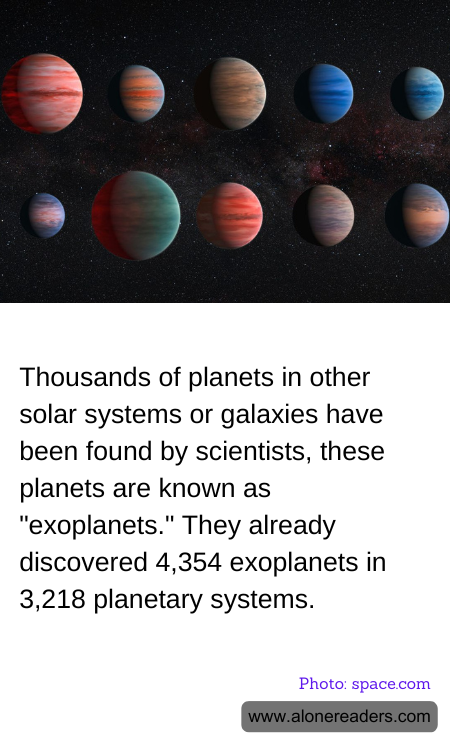
In recent years, the field of astronomy has witnessed remarkable advancements, particularly in the discovery of planets beyond our solar system, known as exoplanets. These celestial bodies, which orbit stars outside our solar system, have captured the imagination of scientists and the public alike. As of now, astronomers have identified 4,354 exoplanets in 3,218 planetary systems, a testament to the vastness and diversity of our universe.
The discovery of exoplanets has been made possible through the use of sophisticated technology and innovative methods. One of the most successful techniques is the transit method, which involves observing the slight dimming of a star as a planet passes in front of it. This method has been employed by space telescopes like Kepler and TESS, which have significantly contributed to the growing catalog of exoplanets. Another method, known as radial velocity, detects the gravitational pull of a planet on its host star, causing the star to wobble slightly. These techniques, among others, have allowed scientists to uncover a wide array of exoplanets, ranging from gas giants similar to Jupiter to rocky planets akin to Earth.
The discovery of exoplanets has profound implications for our understanding of the universe and the potential for life beyond Earth. Among the thousands of exoplanets identified, some reside in the so-called "habitable zone" of their stars, where conditions might be right for liquid water to exist. This raises intriguing possibilities about the existence of life elsewhere in the cosmos. While no definitive evidence of extraterrestrial life has been found, the study of exoplanets continues to fuel scientific inquiry and inspire future exploration.
Moreover, the study of exoplanets provides valuable insights into the formation and evolution of planetary systems. By examining the characteristics of these distant worlds, scientists can compare them to our own solar system, enhancing our understanding of how planets form and evolve over time. This comparative analysis helps refine models of planetary formation and sheds light on the unique conditions that led to the development of life on Earth.
As technology advances, the search for exoplanets is expected to become even more precise and comprehensive. Upcoming missions, such as the James Webb Space Telescope, promise to expand our knowledge by providing more detailed observations of exoplanetary atmospheres and compositions. These efforts will not only deepen our understanding of these distant worlds but also bring us closer to answering one of humanity's most profound questions: Are we alone in the universe?
In conclusion, the discovery of thousands of exoplanets marks a significant milestone in our quest to understand the cosmos. Each new finding adds to the tapestry of knowledge about the universe, offering tantalizing glimpses into the possibilities that lie beyond our solar system. As scientists continue to explore these distant worlds, the potential for groundbreaking discoveries remains boundless, inviting us to ponder the mysteries of the universe and our place within it.
