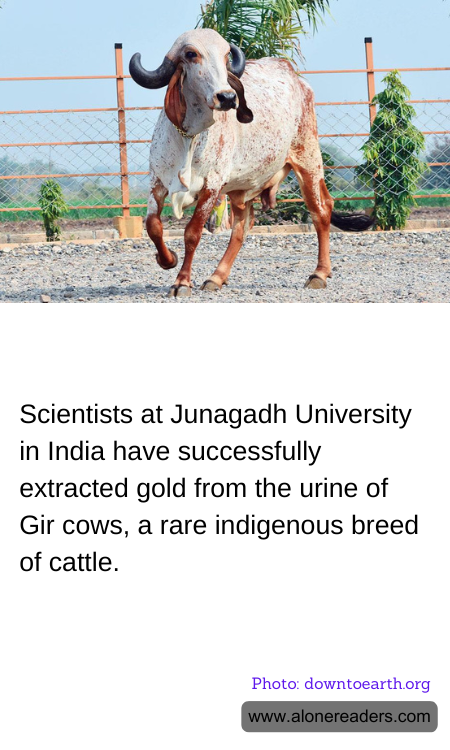
In a groundbreaking development, scientists at Junagadh University in India have successfully extracted gold from the urine of Gir cows, a rare and revered indigenous breed. This remarkable discovery has captured the attention of researchers and the public alike, highlighting the unique properties of this cattle breed and opening new avenues for scientific exploration.
The Gir cow, native to the Gir forest region of Gujarat, is well-known for its resilience and adaptability to harsh climates. It has long been valued for its milk, which is rich in nutrients and considered to have medicinal properties. However, the recent findings by the scientists at Junagadh University have added a new dimension to the significance of this breed. The research team, led by Dr. B.A. Golakia, embarked on this study to explore the potential benefits of Gir cow urine, which has been traditionally used in Ayurvedic medicine.
Through a meticulous process, the researchers were able to isolate trace amounts of gold in the form of gold salts from the urine. The extraction process involved filtering the urine and subjecting it to chemical analysis, which revealed the presence of gold particles. While the quantity of gold extracted is minuscule, the implications of this discovery are profound. It suggests that the Gir cow's unique metabolism might be responsible for this phenomenon, a subject that warrants further investigation.
The discovery has sparked interest not only in the scientific community but also among environmentalists and advocates of traditional medicine. It underscores the potential of indigenous breeds and traditional practices in contributing to modern science and technology. Moreover, it raises questions about the conservation of such breeds, which are often overshadowed by high-yielding foreign cattle breeds in commercial dairy farming.
While the extraction of gold from cow urine might seem like a novelty, it is a testament to the untapped potential of natural resources and the importance of preserving biodiversity. The researchers at Junagadh University are optimistic about the future applications of their findings. They believe that with further research, it might be possible to enhance the extraction process and explore the potential health benefits of the gold compounds found in the urine.
This discovery also highlights the need for a balanced approach to scientific research, one that respects traditional knowledge while embracing modern techniques. As the world grapples with environmental challenges and the need for sustainable practices, such innovations could pave the way for more eco-friendly solutions.
In conclusion, the successful extraction of gold from the urine of Gir cows by scientists at Junagadh University is a fascinating development that bridges traditional wisdom and modern science. It serves as a reminder of the rich resources that nature offers and the importance of preserving indigenous breeds. As research continues, this discovery could lead to new insights and applications, benefiting both science and society.
