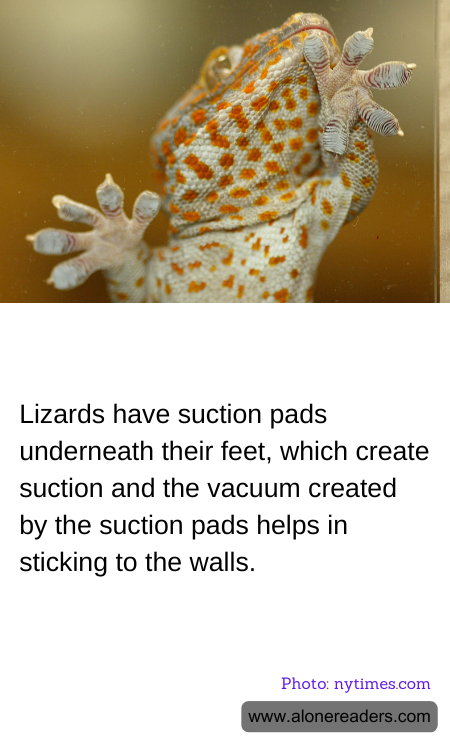
Lizards are fascinating creatures that have captivated the curiosity of scientists and nature enthusiasts alike. One of their most intriguing features is their ability to effortlessly scale vertical surfaces, a skill that seems to defy gravity. This remarkable ability is largely due to the specialized structures found on the undersides of their feet, commonly referred to as suction pads. These pads enable lizards to stick to walls and other surfaces with ease, allowing them to navigate their environments with agility and precision.
The secret behind this impressive climbing ability lies in the microscopic anatomy of the lizard's feet. Unlike the suction cups we might use in everyday life, the pads on a lizard's feet do not rely on traditional suction. Instead, they are covered with millions of tiny hair-like structures known as setae. Each seta branches out into even smaller structures called spatulae. These spatulae are so small that they interact with the surface at a molecular level, taking advantage of van der Waals forces. These are weak intermolecular forces that occur between molecules, allowing the lizard to adhere to surfaces without the need for any adhesive substances.
The vacuum effect created by these structures is not a true vacuum in the sense of removing air to create suction. Instead, the setae and spatulae increase the surface area in contact with the wall, enhancing the forces of attraction between the lizard's foot and the surface. This allows the lizard to maintain a strong grip even on smooth surfaces like glass. The lizard can easily detach its foot by changing the angle at which it contacts the surface, breaking the molecular interactions and allowing it to move freely.
This natural adaptation is not only a marvel of evolution but also a source of inspiration for scientists and engineers. Researchers are studying the mechanics of lizard feet to develop new materials and technologies, such as advanced adhesives and climbing robots, that mimic the lizard's ability to stick to surfaces. These innovations could have wide-ranging applications, from medical devices to construction tools, showcasing how nature often provides solutions to complex engineering challenges.
Lizards, with their seemingly magical ability to walk on walls, remind us of the wonders of the natural world and the intricate designs that evolution can produce. Their suction pads are a testament to the power of adaptation and the potential for nature-inspired technology to transform our lives. As we continue to explore and understand these remarkable creatures, we gain not only a deeper appreciation for the diversity of life on Earth but also valuable insights that could shape the future of human innovation.
