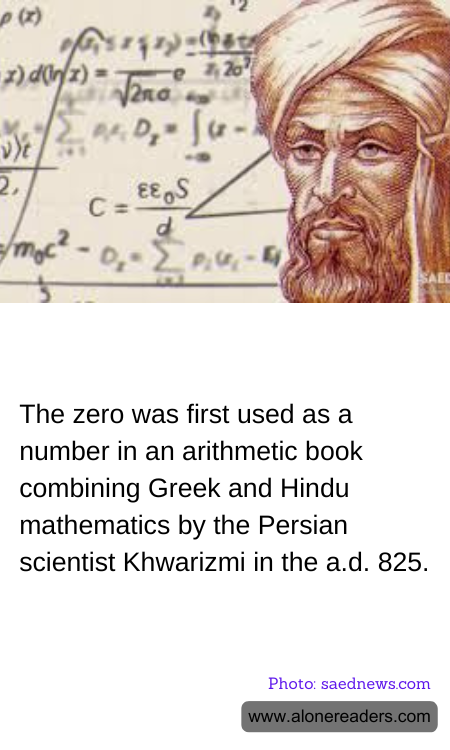
In the annals of mathematical history, few concepts have had as profound an impact as the introduction of zero as a number. This seemingly simple idea revolutionized mathematics and laid the groundwork for modern arithmetic. The credit for this pivotal development goes to the Persian scientist Muhammad ibn Musa al-Khwarizmi, who, in A.D. 825, authored an arithmetic book that ingeniously combined Greek and Hindu mathematical principles.
Before the advent of zero as a number, ancient civilizations struggled with the limitations of their numerical systems. The Greeks, for instance, had a sophisticated understanding of mathematics but lacked a symbol for zero, which made calculations cumbersome and limited their ability to perform complex arithmetic. Similarly, the Romans used an additive system that was effective for trade and commerce but was not conducive to advanced mathematical operations.
The Hindu mathematicians, however, had already begun to conceptualize zero as a number by the 5th century A.D. They used a dot to represent an empty place in their positional number system, which was a significant leap forward. This innovation allowed for more efficient calculations and the development of algebra. It was this Hindu numeral system that al-Khwarizmi encountered and subsequently introduced to the Islamic world.
Al-Khwarizmi's work, particularly his book "Kitab al-Jam' wal-Tafreeq bil Hisab al-Hindi" (The Book of Addition and Subtraction According to the Hindu Calculation), was instrumental in disseminating the concept of zero. In this text, he not only explained the use of Hindu numerals but also demonstrated how zero could be used as a placeholder and a number in its own right. This was a groundbreaking shift from previous systems and allowed for the development of more sophisticated mathematical techniques.
The introduction of zero had far-reaching implications. It enabled the development of algebra, calculus, and the binary system, which are foundational to modern science and technology. The ability to perform calculations with zero as a number also facilitated advancements in engineering, astronomy, and commerce, driving progress across various fields.
Al-Khwarizmi's contributions extended beyond the introduction of zero. His works laid the foundation for the development of algorithms, a term derived from his name, which are essential to computer science today. His synthesis of Greek and Hindu mathematics not only enriched the Islamic Golden Age but also paved the way for the Renaissance and the eventual global spread of these ideas.
In conclusion, the introduction of zero as a number by al-Khwarizmi was a transformative moment in the history of mathematics. It bridged the gap between ancient and modern mathematical thought, enabling the development of new theories and technologies that continue to shape our world. This remarkable achievement underscores the importance of cross-cultural exchanges in the advancement of human knowledge and serves as a testament to the enduring legacy of al-Khwarizmi's work.
