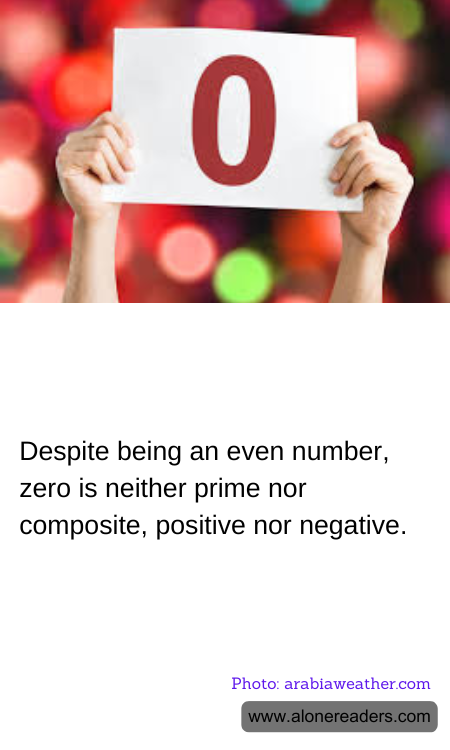
Zero, a seemingly simple number, holds a unique position in the world of mathematics. Despite being an even number, it defies classification as either prime or composite, and it stands apart from the realms of positive and negative numbers. This enigmatic nature makes zero a fascinating subject for mathematicians and curious minds alike.
To understand why zero is considered even, we must first revisit the definition of even numbers. An even number is any integer that can be divided by two without leaving a remainder. Zero fits this definition perfectly, as dividing zero by two results in zero, with no remainder. This characteristic places zero firmly within the category of even numbers, yet it remains distinct from other even numbers due to its unique properties.
When it comes to prime and composite numbers, zero again stands apart. A prime number is defined as a natural number greater than one that has no divisors other than one and itself. Conversely, a composite number is a natural number greater than one that has more than two distinct positive divisors. Zero does not meet the criteria for either category, as it is not greater than one and cannot be expressed as a product of natural numbers. Thus, zero is neither prime nor composite, existing outside these traditional classifications.
Zero's neutrality extends to its position on the number line, where it serves as the dividing point between positive and negative numbers. Positive numbers are those greater than zero, while negative numbers are those less than zero. Zero itself is neither, acting as the boundary between these two sets. This neutrality allows zero to play a crucial role in mathematics, serving as a reference point for measuring and comparing values.
The concept of zero has profound implications beyond its mathematical properties. Historically, the introduction of zero revolutionized mathematics, enabling the development of algebra and calculus. Its role as a placeholder in our number system allows for the representation of large numbers and the performance of complex calculations. Zero's neutrality and versatility make it an indispensable tool in various fields, from engineering to computer science.
In everyday life, zero often represents the absence of quantity, such as when a bank account balance reads zero or when a thermometer registers zero degrees. This ability to signify nothingness is a testament to zero's unique position in both mathematics and the real world. Despite its simplicity, zero's properties and applications are vast and varied, making it a subject of endless intrigue and study.
In conclusion, zero is a number that defies easy categorization. While it is an even number, it is neither prime nor composite, and it occupies a neutral position between positive and negative numbers. Its unique characteristics have made it a cornerstone of mathematics and a symbol of balance and neutrality. Zero's enigmatic nature continues to captivate and inspire, proving that even the simplest concepts can hold profound significance.
