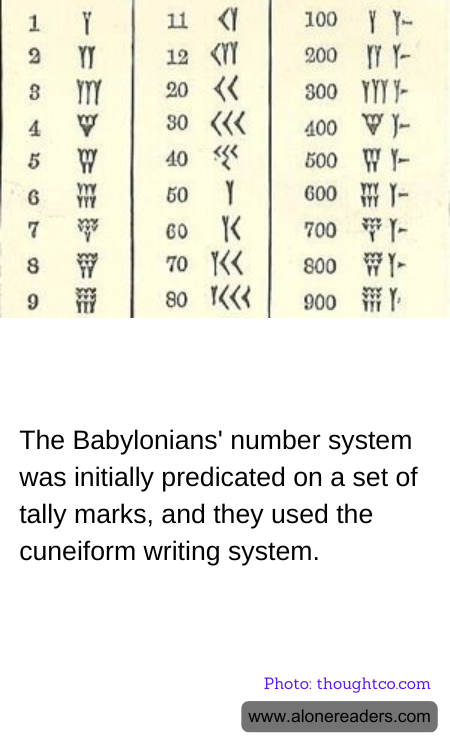
The Babylonians, an ancient civilization that thrived in Mesopotamia, are renowned for their contributions to mathematics and writing. Their number system, which laid the groundwork for many modern mathematical concepts, was initially based on a set of tally marks. This system was both innovative and practical, reflecting the Babylonians' advanced understanding of mathematics and their ability to adapt their writing system to suit their needs.
At the heart of the Babylonian number system was the use of a base-60, or sexagesimal, system. This choice was likely influenced by the practical advantages it offered, such as the ease of dividing numbers into fractions. The number 60 is divisible by many smaller numbers, making it particularly useful for calculations involving fractions, which were essential for trade, astronomy, and other aspects of daily life. The Babylonians represented numbers using a combination of two symbols: a vertical wedge for the number one and a corner wedge for the number ten. By arranging these symbols in various combinations, they could represent numbers up to 59, after which they would start a new place value, similar to how we use place value in our decimal system.
The Babylonians' use of tally marks was closely linked to their writing system, known as cuneiform. Cuneiform, one of the earliest forms of writing, was developed by the Sumerians and later adapted by the Babylonians. It involved pressing a reed stylus into soft clay tablets to create wedge-shaped impressions. This method of writing was well-suited to the Babylonians' environment, as clay was abundant in the region. The durability of clay tablets also ensured that many of these ancient records have survived to this day, providing valuable insights into Babylonian society and their mathematical achievements.
The integration of the number system with cuneiform writing allowed the Babylonians to record complex calculations and astronomical observations with remarkable precision. They used their mathematical knowledge to develop sophisticated calendars, predict celestial events, and solve quadratic equations. The legacy of their number system is still evident today, particularly in the way we measure time and angles. The division of an hour into 60 minutes and a circle into 360 degrees are direct descendants of the Babylonian base-60 system.
In conclusion, the Babylonians' number system, initially based on tally marks and expressed through the cuneiform writing system, was a testament to their ingenuity and mathematical prowess. Their innovative approach to numbers and writing not only facilitated the administration of their society but also laid the foundation for future civilizations to build upon. As we continue to explore the history of mathematics, the contributions of the Babylonians remain a fascinating and integral part of our understanding of the ancient world.
