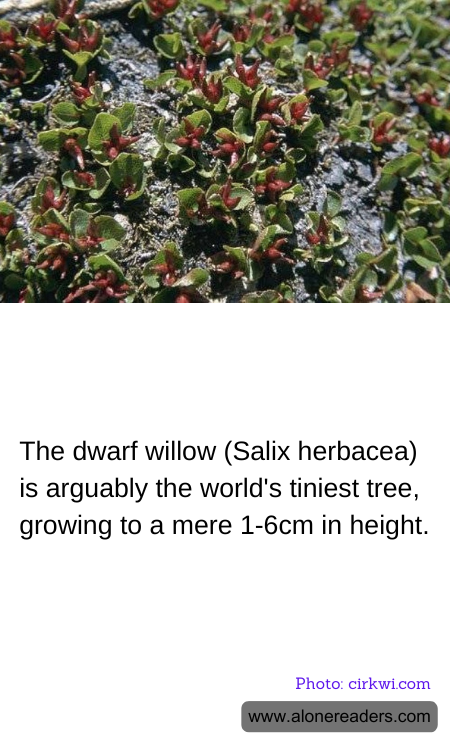
In the vast tapestry of the plant kingdom, where towering redwoods and sprawling oaks often steal the spotlight, there exists a humble contender for the title of the world's tiniest tree: the dwarf willow, scientifically known as Salix herbacea. This diminutive marvel of nature challenges our conventional understanding of what a tree can be, standing at a mere 1 to 6 centimeters in height. Despite its small stature, the dwarf willow is a testament to the resilience and adaptability of life in some of the planet's harshest environments.
The dwarf willow is native to the Arctic and alpine regions of Europe and North America, where it thrives in conditions that would be inhospitable to most other trees. Its ability to survive in such extreme climates is a remarkable feat. The plant's small size is an adaptation to the cold, windy environments it inhabits. By hugging the ground, the dwarf willow minimizes exposure to harsh winds and maximizes the warmth from the sun-soaked soil. This low profile also helps it avoid damage from heavy snow and ice, which can easily break taller plants.
Despite its unassuming appearance, the dwarf willow plays a crucial role in its ecosystem. It provides food and habitat for a variety of insects and small animals. Its leaves, though tiny, are a source of nourishment for herbivores like reindeer and lemmings. Additionally, the dwarf willow contributes to soil stabilization and nutrient cycling, supporting the fragile ecosystems of the tundra and alpine regions.
The dwarf willow's lifecycle is another fascinating aspect of its existence. It is a deciduous plant, meaning it sheds its leaves annually. In the brief Arctic summer, it produces small, catkin-like flowers that are pollinated by insects. This brief flowering period is a critical time for the plant, as it must quickly reproduce before the harsh winter returns. The seeds are then dispersed by the wind, allowing the plant to colonize new areas.
For botanists and nature enthusiasts alike, the dwarf willow is a symbol of nature's ingenuity. It challenges our perceptions of what a tree can be and serves as a reminder of the diverse strategies plants employ to survive and thrive. In a world where the tallest and largest often capture our attention, the dwarf willow stands as a quiet testament to the beauty and complexity of life at the smallest scale.
In conclusion, the dwarf willow is more than just a botanical curiosity; it is a vital component of its ecosystem and a remarkable example of adaptation. Its ability to endure and flourish in extreme conditions is a powerful reminder of the resilience of nature. As we continue to explore and understand the natural world, the dwarf willow invites us to appreciate the wonders that exist in even the smallest corners of our planet.
