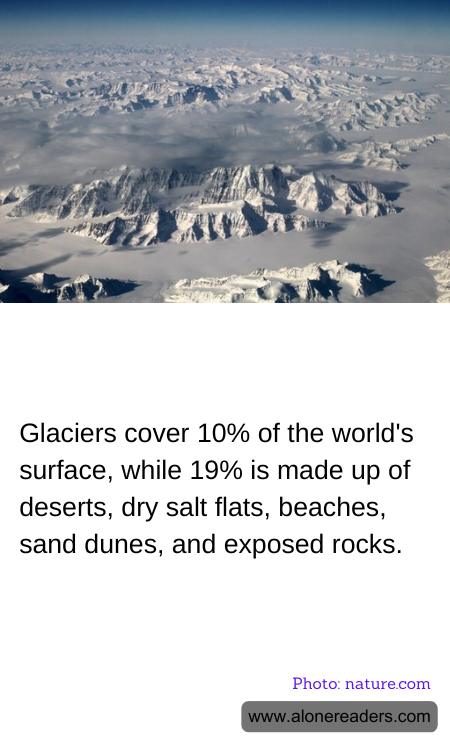
The Earth's surface is a tapestry of diverse landscapes, each contributing uniquely to the planet's ecological balance and beauty. Among these, glaciers and arid regions stand out, covering significant portions of the globe and playing crucial roles in the Earth's environmental systems.
Glaciers, vast masses of ice that move slowly over land, cover approximately 10% of the Earth's surface. These frozen giants are not only breathtakingly beautiful but also vital to the planet's health. Glaciers are found on every continent except Australia, with the largest concentrations in Antarctica and Greenland. They serve as crucial freshwater reservoirs, storing about 69% of the world's freshwater. As they melt, glaciers release this water into rivers and oceans, influencing sea levels and providing water for millions of people. Moreover, glaciers are essential indicators of climate change. Their retreat or advance offers scientists valuable insights into global temperature trends and environmental shifts.
In stark contrast to the icy expanses of glaciers are the Earth's arid regions, which make up about 19% of the surface. This category includes deserts, dry salt flats, beaches, sand dunes, and exposed rocks. Deserts, such as the Sahara and the Arabian Desert, are characterized by their extreme temperatures and scarce rainfall. Despite their harsh conditions, deserts are home to a surprising variety of life forms that have adapted to survive with minimal water. These ecosystems are fragile and can be significantly impacted by human activities and climate change.
Dry salt flats, like those found in Bolivia's Salar de Uyuni, are otherworldly landscapes that captivate with their stark beauty. These flats are remnants of ancient lakes that have evaporated, leaving behind vast expanses of salt. They are not only tourist attractions but also hold economic importance due to their mineral deposits, including lithium, a key component in batteries.
Beaches and sand dunes, often associated with leisure and recreation, are dynamic environments shaped by wind and water. They provide habitats for various species and act as natural barriers against coastal erosion. However, they are increasingly threatened by rising sea levels and human development.
Exposed rocks, found in mountainous regions and other areas, tell the geological history of the Earth. They offer clues about the planet's formation and the processes that have shaped its surface over millions of years.
Together, glaciers and arid regions highlight the Earth's incredible diversity. They remind us of the delicate balance that sustains life on our planet and the importance of preserving these natural wonders. As climate change and human activities continue to alter these landscapes, it becomes ever more crucial to understand and protect them for future generations. Through conservation efforts and sustainable practices, we can ensure that these vital parts of the Earth's surface continue to thrive and inspire awe in all who encounter them.
