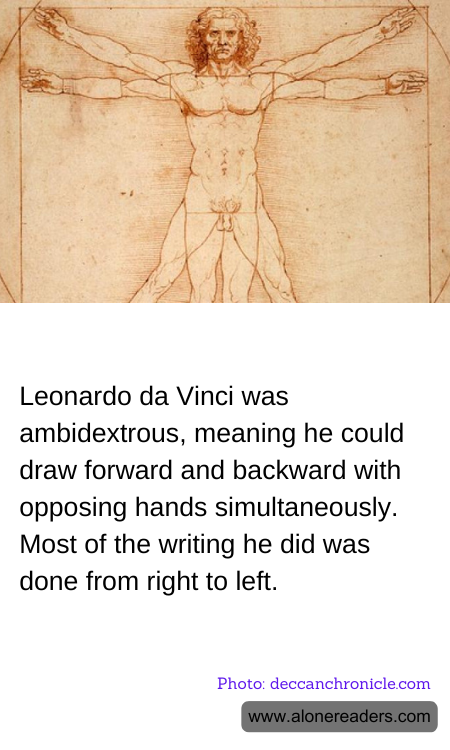
Leonardo da Vinci, the quintessential Renaissance man, is renowned for his extraordinary contributions to art, science, and engineering. Among his many talents, one of the most fascinating aspects of his genius was his ambidexterity. Leonardo's ability to use both hands with equal skill allowed him to draw forward and backward simultaneously, a feat that continues to intrigue scholars and enthusiasts alike.
Ambidexterity is a rare trait, and in Leonardo's case, it was not just a party trick but a practical tool that enhanced his work. His ability to write and draw with both hands enabled him to explore ideas in a unique and efficient manner. This skill was particularly useful when he was engaged in complex projects that required a high level of detail and precision. By using both hands, Leonardo could maintain a continuous flow of creativity, switching seamlessly between tasks without the interruption of repositioning his tools.
One of the most intriguing aspects of Leonardo's ambidexterity was his penchant for mirror writing. Most of his notes and journals were written from right to left, a technique that has puzzled historians for centuries. Some speculate that this method was a way to keep his ideas secret, as the reversed script would be difficult for others to read without a mirror. Others believe it was simply more comfortable for him as a left-handed writer, allowing him to avoid smudging the ink as he wrote.
Leonardo's mirror writing is more than just a curiosity; it reflects his innovative approach to problem-solving and his willingness to defy convention. His notebooks, filled with sketches, observations, and musings, are a testament to his insatiable curiosity and his desire to understand the world around him. The use of mirror writing in these journals underscores his commitment to exploring ideas from every possible angle, both literally and figuratively.
In addition to his ambidexterity, Leonardo's ability to think and work in multiple dimensions set him apart from his contemporaries. His dual-handed drawing technique allowed him to create intricate designs and detailed anatomical studies that were far ahead of his time. This skill was not only a testament to his dexterity but also to his unparalleled ability to visualize and conceptualize complex ideas.
Leonardo da Vinci's ambidexterity is a remarkable example of how physical abilities can enhance intellectual pursuits. His ability to draw and write with both hands was not just a novelty but a crucial aspect of his creative process. It allowed him to explore ideas with a fluidity and depth that few others could match. Today, Leonardo's legacy continues to inspire artists, scientists, and thinkers, reminding us of the limitless potential of the human mind and the extraordinary achievements that can result from embracing our unique talents.
