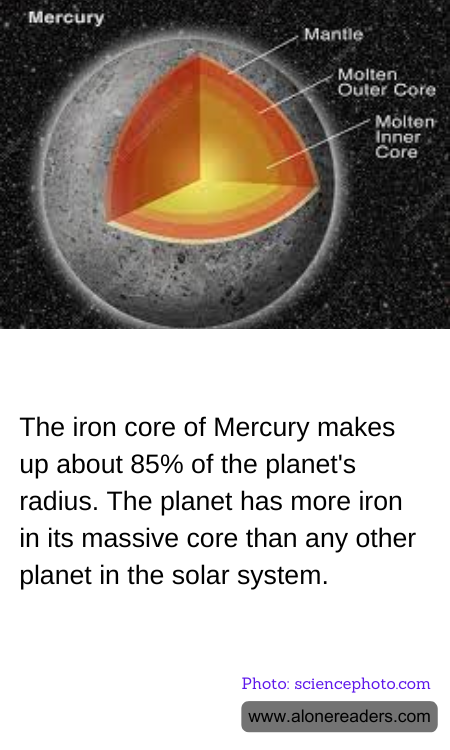
Mercury, the closest planet to the Sun, is a world of extremes and mysteries. Despite being the smallest planet in our solar system, it boasts a feature that makes it stand out in the cosmic neighborhood: its massive iron core. This core is so significant that it constitutes about 85% of Mercury's radius, making it the most iron-rich planet in our solar system.
The composition of Mercury has intrigued scientists for decades. Unlike Earth, which has a relatively thin crust and mantle surrounding its core, Mercury's core dominates its structure. This iron core is not only large but also dense, contributing to the planet's high density, second only to Earth. The sheer size of Mercury's core suggests that the planet may have formed under unique conditions or undergone significant changes since its formation.
One prevailing theory about Mercury's massive core is that it might have been the result of a colossal collision in the early solar system. Such an impact could have stripped away much of Mercury's original rocky mantle, leaving behind a planet with a disproportionately large core. This hypothesis aligns with the planet's thin silicate crust and mantle, which are much less substantial compared to its core.
Mercury's iron core also plays a crucial role in generating its magnetic field. Although weaker than Earth's, Mercury's magnetic field is a fascinating feature for a planet of its size. This magnetic field is believed to be generated by the movement of molten iron within the core, similar to the geodynamo process that occurs on Earth. The presence of this magnetic field provides valuable insights into the planet's internal structure and thermal history.
The study of Mercury's core is not just an academic pursuit; it holds broader implications for understanding planetary formation and evolution. By examining Mercury, scientists can gain insights into the processes that shaped not only our solar system but also exoplanetary systems beyond. The planet's unique characteristics challenge existing models and encourage the development of new theories about planetary development.
In recent years, missions like NASA's MESSENGER and the European Space Agency's BepiColombo have provided unprecedented data about Mercury. These missions have helped to map the planet's surface, analyze its composition, and study its magnetic field, offering a clearer picture of its enigmatic core. As technology advances, future missions may unlock even more secrets about this iron-rich world.
Mercury's massive iron core is a testament to the diverse and dynamic nature of our solar system. It serves as a reminder of the complex processes that govern planetary formation and the unique characteristics that can arise from these processes. As we continue to explore and study Mercury, we not only learn more about this small, iron-rich planet but also about the broader universe and our place within it.
