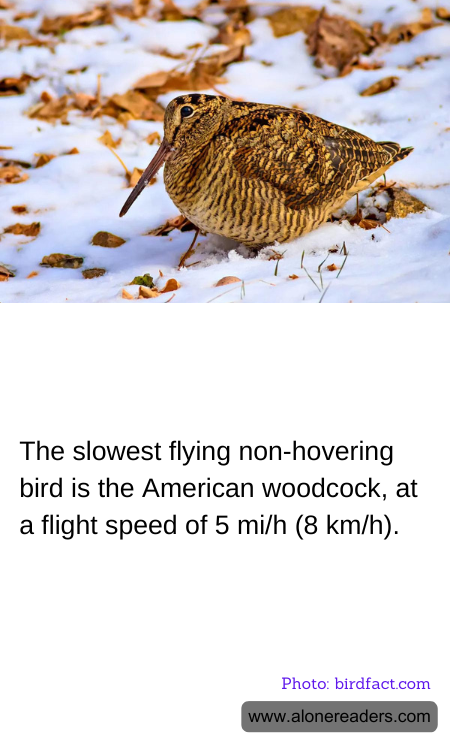
The American woodcock, a bird often celebrated for its unique courtship dance and cryptic plumage, holds a fascinating record in the avian world. Known for its slow flight, the American woodcock is recognized as the slowest flying non-hovering bird, cruising at a leisurely pace of just 5 miles per hour (8 kilometers per hour). This intriguing characteristic sets it apart from its faster-flying counterparts and offers a glimpse into the diverse adaptations of bird species.
The American woodcock, also affectionately known as the "timberdoodle," is a member of the sandpiper family. It is primarily found in the eastern regions of North America, where it inhabits moist, young forests and shrubby fields. Its mottled brown and gray plumage provides excellent camouflage against the forest floor, making it a master of disguise. This bird's slow flight is not a disadvantage but rather an adaptation that complements its lifestyle and habitat.
Unlike many birds that rely on speed to escape predators or migrate long distances, the American woodcock's slow flight is well-suited to its environment. Its leisurely pace allows it to navigate through dense underbrush and forested areas with ease, avoiding obstacles that might hinder faster-flying birds. This slow and steady approach is particularly advantageous during its elaborate courtship display, where the male performs a mesmerizing aerial dance to attract a mate. The display involves a series of spiraling flights and melodious calls, showcasing the woodcock's agility and grace despite its slow speed.
The American woodcock's diet primarily consists of earthworms, which it skillfully extracts from the soil using its long, sensitive bill. This feeding behavior is another reason for its slow flight, as it spends much of its time foraging on the ground. The bird's ability to detect and capture prey beneath the surface is a testament to its specialized adaptations, which prioritize precision and stealth over speed.
While the American woodcock may not win any races in the sky, its unique characteristics highlight the incredible diversity of the avian world. Each bird species has evolved to thrive in its specific niche, and the woodcock's slow flight is a perfect example of nature's ingenuity. By embracing its leisurely pace, the American woodcock has carved out a successful existence in its woodland habitat, captivating birdwatchers and nature enthusiasts with its charm and distinctive behaviors.
In a world where speed often seems to be the ultimate measure of success, the American woodcock reminds us that sometimes, taking things slow can be just as effective. Its gentle flight and fascinating lifestyle offer a valuable lesson in adaptation and survival, proving that in nature, there is no single path to success.
