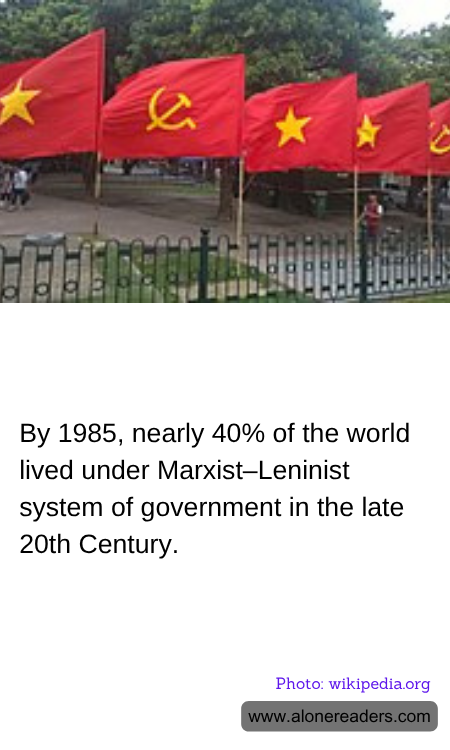
In the late 20th century, the world witnessed a significant geopolitical shift as nearly 40% of its population lived under Marxist-Leninist systems of government by 1985. This era marked a period of profound ideological influence, where the principles of Marxism-Leninism, rooted in the ideas of Karl Marx and Vladimir Lenin, shaped the political, economic, and social landscapes of numerous countries.
The spread of Marxist-Leninist ideology was largely propelled by the aftermath of World War II and the subsequent Cold War era. The Soviet Union, emerging as a superpower, played a pivotal role in promoting this ideology across Eastern Europe, Asia, Africa, and Latin America. Countries such as China, Cuba, Vietnam, and North Korea adopted Marxist-Leninist principles, each adapting the ideology to fit their unique cultural and historical contexts. The appeal of Marxism-Leninism lay in its promise of a classless society, where the means of production were collectively owned, and wealth was distributed more equitably among the populace.
In Eastern Europe, the Soviet Union's influence was particularly pronounced. Nations like Poland, East Germany, Czechoslovakia, Hungary, Romania, and Bulgaria found themselves within the Soviet sphere, adopting Marxist-Leninist governance models. These countries experienced significant changes, including the nationalization of industries, collectivization of agriculture, and the establishment of one-party states. While these changes aimed to create more equitable societies, they often led to economic inefficiencies and political repression.
In Asia, the People's Republic of China emerged as a major proponent of Marxist-Leninist ideology following the Chinese Revolution in 1949. Under the leadership of Mao Zedong, China embarked on ambitious programs such as the Great Leap Forward and the Cultural Revolution, which sought to transform the nation into a socialist society. Similarly, Vietnam, after a prolonged struggle for independence, unified under a Marxist-Leninist government in 1975, further expanding the ideology's reach in Southeast Asia.
The influence of Marxist-Leninism extended to Latin America and Africa as well. In Cuba, Fidel Castro's revolution in 1959 established a Marxist-Leninist state just 90 miles from the United States, significantly impacting Cold War dynamics. In Africa, countries like Angola, Mozambique, and Ethiopia embraced Marxist-Leninist principles during their post-colonial transitions, seeking to address issues of inequality and underdevelopment.
Despite its widespread adoption, the Marxist-Leninist system faced numerous challenges. Economic stagnation, lack of political freedoms, and the inability to adapt to changing global dynamics led to growing discontent among populations. By the late 1980s, the world began to witness the decline of Marxist-Leninist regimes, culminating in the fall of the Berlin Wall in 1989 and the dissolution of the Soviet Union in 1991.
The legacy of Marxist-Leninism in the late 20th century is complex. While it aimed to create more just and equitable societies, its implementation often resulted in authoritarianism and economic hardship. Nonetheless, the period remains a significant chapter in global history, illustrating the profound impact of ideology on world affairs and the enduring quest for social justice and equality.
