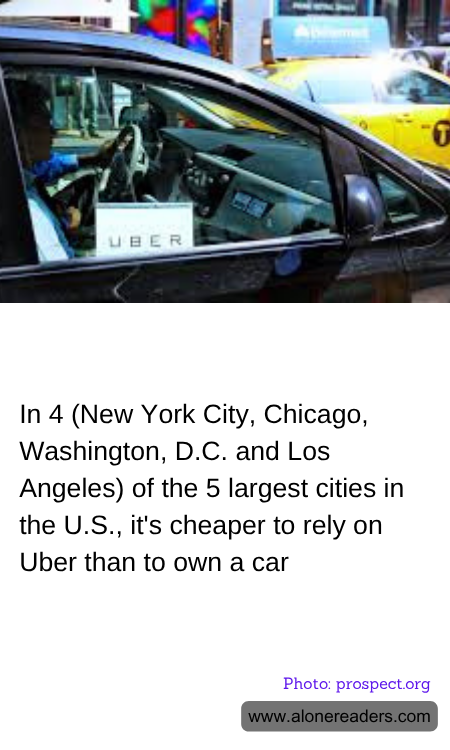
In today's fast-paced urban environments, the cost of owning a car can be a significant financial burden. Recent studies have shown that in four of the five largest cities in the United States—New York City, Chicago, Washington, D.C., and Los Angeles—relying on ride-sharing services like Uber can be more economical than owning a personal vehicle. This revelation is reshaping how city dwellers approach transportation and manage their budgets.
Owning a car in a bustling metropolis comes with a myriad of expenses. Beyond the initial purchase price, car owners must contend with insurance premiums, maintenance costs, parking fees, and fluctuating fuel prices. In cities like New York and Chicago, where parking alone can cost hundreds of dollars a month, these expenses quickly add up. Additionally, the time spent navigating congested streets and searching for parking can be both frustrating and costly in terms of lost productivity.
In contrast, ride-sharing services offer a flexible and often more affordable alternative. With Uber, users pay only for the rides they take, eliminating the fixed costs associated with car ownership. This pay-as-you-go model is particularly appealing in cities where public transportation is robust and can be used in conjunction with ride-sharing to cover longer distances or less accessible areas. Moreover, the convenience of being dropped off directly at one's destination without the hassle of parking is a significant advantage.
In Washington, D.C., and Los Angeles, the scenario is similar. While these cities have their own unique transportation challenges, the cost of owning a car remains high. In Los Angeles, for example, the sprawling nature of the city and notorious traffic jams make car ownership less appealing. Uber provides a viable alternative, allowing residents to avoid the stress of driving while potentially saving money. In Washington, D.C., where public transportation is widely used, supplementing it with Uber rides can be a cost-effective strategy for those who need occasional car access.
However, it's important to note that the economics of ride-sharing versus car ownership can vary based on individual circumstances. Factors such as the frequency of travel, distance of commutes, and personal preferences play a crucial role in determining which option is more cost-effective. For some, the convenience and freedom of having a personal vehicle may outweigh the financial savings offered by ride-sharing services.
As urban landscapes continue to evolve, the transportation choices available to city residents are expanding. The rise of ride-sharing services like Uber is challenging traditional notions of car ownership, offering a flexible and often cheaper alternative in some of the largest U.S. cities. For many, this shift represents not only a financial benefit but also a step towards a more sustainable and less congested urban environment.
