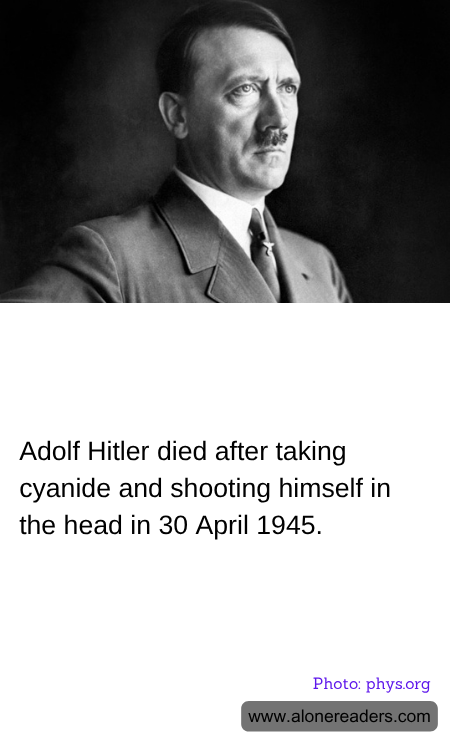
On April 30, 1945, Adolf Hitler, the infamous leader of Nazi Germany, met his end in a manner that has been the subject of historical scrutiny and public fascination for decades. As the Allies closed in on Berlin, Hitler retreated to his underground bunker, the Führerbunker, where he spent his final days. Faced with the inevitable defeat of the Third Reich, Hitler chose to end his life rather than face capture.
The circumstances of Hitler's death have been well-documented. In the early afternoon of April 30, Hitler and his long-time companion, Eva Braun, whom he had married just the day before, retreated to his private quarters within the bunker. It was there that Hitler ingested a cyanide capsule and simultaneously shot himself in the head. This dual method of suicide was likely chosen to ensure that his death would be swift and certain. Eva Braun also took cyanide, choosing to die alongside Hitler.
The decision to commit suicide was not made lightly. Hitler had been informed of the dire situation facing Germany, with Soviet forces advancing rapidly into Berlin. The once-mighty Nazi regime was crumbling, and Hitler's dream of a thousand-year Reich was in ruins. Rather than surrender and face the humiliation of capture, Hitler opted for death, a decision that he had reportedly contemplated for some time.
Following their deaths, the bodies of Hitler and Braun were discovered by members of his inner circle. In accordance with Hitler's instructions, their bodies were carried to the garden of the Reich Chancellery, doused in petrol, and set alight. This was done to prevent their remains from being captured and displayed by the advancing Soviet troops. The charred remains were later discovered by Soviet forces, leading to a series of investigations that confirmed Hitler's death.
The death of Adolf Hitler marked the end of a dark chapter in history. His leadership had plunged the world into a devastating conflict that resulted in the loss of millions of lives. The atrocities committed under his regime, including the Holocaust, left an indelible scar on humanity. Hitler's suicide, while bringing an end to his personal reign of terror, did not erase the horrors he had unleashed.
In the years since, Hitler's death has been the subject of numerous conspiracy theories and debates. However, the consensus among historians is clear: on April 30, 1945, Adolf Hitler chose to end his life in a final act of defiance, leaving behind a legacy of destruction and a world forever changed by his actions.
