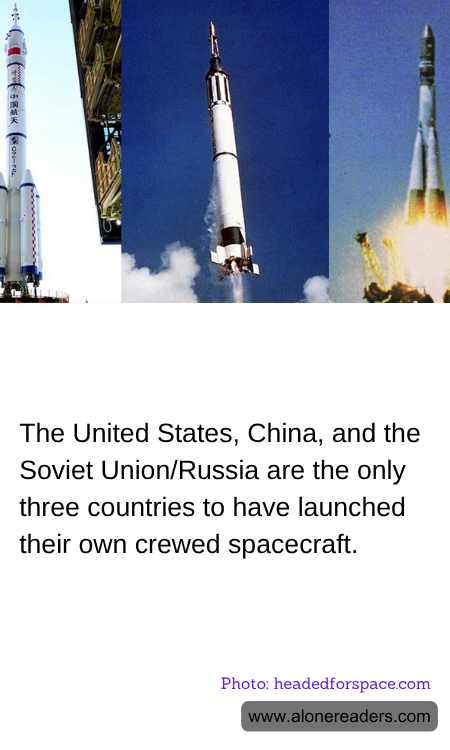
The exploration of space has long been a testament to human ingenuity and ambition. Among the many nations striving to reach beyond our planet, only three have successfully launched their own crewed spacecraft: the United States, China, and the Soviet Union/Russia. This remarkable achievement underscores their technological prowess and commitment to exploring the final frontier.
The journey began with the Soviet Union, which made history on April 12, 1961, when Yuri Gagarin became the first human to orbit the Earth aboard Vostok 1. This monumental event marked the beginning of human space exploration and set the stage for the space race between the Soviet Union and the United States. The Soviets continued to build on their success with a series of missions that demonstrated their capabilities, including the first spacewalk by Alexei Leonov in 1965.
The United States quickly followed suit, driven by President John F. Kennedy's vision to land a man on the Moon. NASA's Mercury and Gemini programs laid the groundwork for the Apollo missions, culminating in the historic Apollo 11 landing on July 20, 1969, when Neil Armstrong and Buzz Aldrin became the first humans to set foot on the lunar surface. This achievement not only fulfilled Kennedy's promise but also established the United States as a leader in space exploration.
In the decades that followed, the United States and the Soviet Union, later succeeded by Russia, continued to advance their space programs. The development of the Space Shuttle by NASA and the Soyuz spacecraft by Russia enabled both nations to maintain a continuous human presence in space, particularly through their collaboration on the International Space Station (ISS). This partnership has been a symbol of international cooperation, transcending political differences to further scientific discovery.
China, the third nation to join this exclusive club, launched its first crewed spacecraft, Shenzhou 5, on October 15, 2003, with astronaut Yang Liwei aboard. This achievement marked China's emergence as a major player in space exploration. Since then, China has made significant strides, including the establishment of its own space station, Tiangong, and ambitious plans for lunar and Mars exploration.
The ability to launch crewed spacecraft is a testament to a nation's technological and scientific capabilities. For the United States, China, and the Soviet Union/Russia, this achievement has not only been a source of national pride but also a platform for advancing human knowledge and fostering international collaboration. As these nations continue to push the boundaries of space exploration, they inspire future generations to dream big and reach for the stars.
