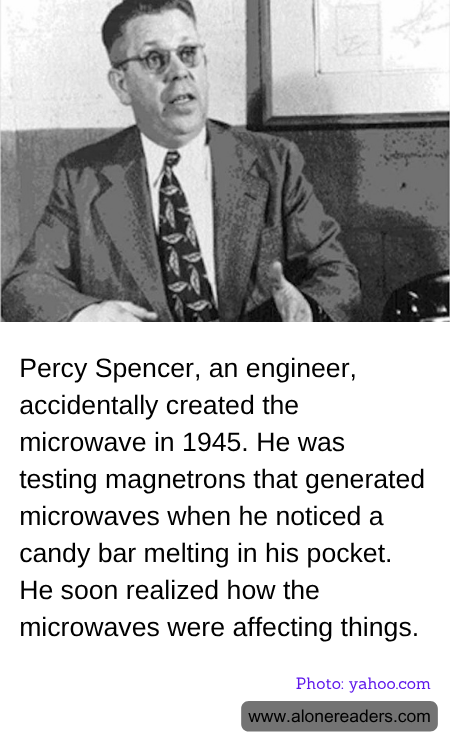
In the annals of accidental inventions, few stories are as intriguing as that of Percy Spencer and the microwave oven. In 1945, Spencer, an engineer working for the Raytheon Corporation, was conducting experiments with magnetrons, devices that generate microwaves, which were primarily used in radar technology during World War II. Little did he know that his work would lead to a revolutionary kitchen appliance that would change the way we cook and reheat food.
The serendipitous discovery occurred when Spencer noticed something unusual during his experiments. As he stood near the magnetron, he felt a peculiar sensation in his pocket. Upon investigation, he found that a candy bar he had been carrying had melted. This unexpected event piqued his curiosity and led him to wonder if the microwaves emitted by the magnetron were responsible for the melting. To test his hypothesis, Spencer placed popcorn kernels near the device, and to his amazement, they began to pop. This was the eureka moment that confirmed the potential of microwaves to heat food.
Spencer's curiosity and ingenuity did not stop there. He quickly realized the broader implications of his discovery and began to experiment with other foods. He placed an egg near the magnetron, which promptly exploded, further demonstrating the power of microwave energy. These experiments laid the groundwork for the development of the first microwave oven, initially called the "Radarange." The first commercial microwave oven was introduced by Raytheon in 1947, and although it was bulky and expensive, it marked the beginning of a new era in culinary technology.
The microwave oven has since become a staple in kitchens worldwide, valued for its speed and convenience. It allows people to quickly reheat leftovers, defrost frozen foods, and even cook entire meals with minimal effort. The invention has not only transformed home cooking but has also had a significant impact on the food industry, leading to the development of microwave-safe packaging and ready-to-eat meals.
Percy Spencer's accidental discovery is a testament to the power of curiosity and the potential for unexpected outcomes in scientific research. His ability to recognize the significance of a melted candy bar and pursue the idea further exemplifies the innovative spirit that drives technological advancement. Today, the microwave oven is a ubiquitous appliance, found in homes, offices, and restaurants around the globe, all thanks to a moment of serendipity and the inquisitive mind of an engineer. Spencer's story serves as a reminder that sometimes, the greatest inventions come from the most unexpected places.
