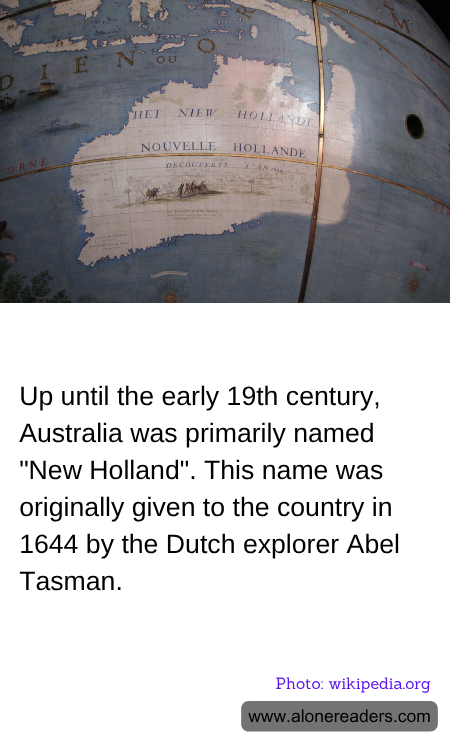
Australia, a land of diverse landscapes and rich history, was not always known by its current name. Up until the early 19th century, this vast continent was primarily referred to as "New Holland." This name was bestowed upon it in 1644 by the Dutch explorer Abel Tasman, who played a significant role in the European exploration of the southern hemisphere.
Abel Tasman, an experienced navigator and seafarer, was commissioned by the Dutch East India Company to explore the unknown territories to the south of the Dutch East Indies, now known as Indonesia. During his voyages, Tasman charted parts of the Australian coastline, including the island that now bears his name, Tasmania. In recognition of these discoveries, he named the entire continent "New Holland," a nod to his homeland, the Netherlands, which was often referred to as Holland.
The name "New Holland" was used by European explorers and mapmakers for over a century and a half. It was a time when the world was still being mapped, and the vast, mysterious landmass of Australia was slowly being unveiled to the European imagination. The Dutch, who were at the forefront of maritime exploration during the 17th century, were instrumental in this process. However, despite their early discoveries, the Dutch did not establish any permanent settlements on the continent.
As the 18th century progressed, other European powers, particularly the British, began to take a keen interest in the region. The British explorer Captain James Cook's voyage in 1770 marked a turning point in the history of Australia. Cook's detailed maps and reports of the eastern coastline, which he claimed for Great Britain, laid the groundwork for future British colonization. This eventually led to the establishment of the first British colony in New South Wales in 1788.
The transition from "New Holland" to "Australia" was gradual. The name "Australia" is derived from the Latin "Terra Australis," meaning "southern land," a term used in ancient times to describe a hypothetical continent in the southern hemisphere. The name gained popularity in the early 19th century, thanks in part to the writings of explorers and naturalists like Matthew Flinders, who advocated for its use. By 1824, the British Admiralty officially adopted "Australia" as the name for the continent.
Today, while the name "New Holland" is largely a historical footnote, it serves as a reminder of the continent's early encounters with European explorers and the rich tapestry of its exploration history. The story of how Australia got its name is a fascinating chapter in the broader narrative of discovery and colonization, reflecting the complex interplay of exploration, naming, and national identity.
