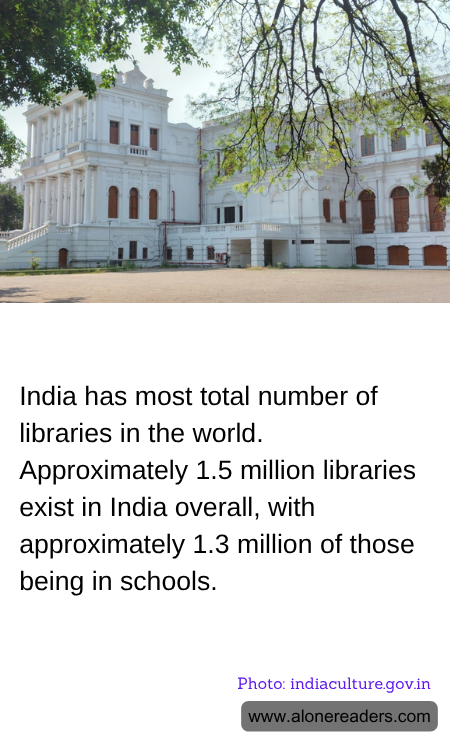
India, a nation renowned for its rich cultural heritage and diverse traditions, has emerged as a global leader in the realm of libraries. With approximately 1.5 million libraries scattered across the country, India boasts the highest number of libraries in the world. This impressive figure underscores the nation's commitment to education and knowledge dissemination, serving as a testament to its dedication to fostering a literate and informed society.
A significant portion of these libraries, around 1.3 million, are housed within schools. This extensive network of school libraries plays a crucial role in shaping the educational landscape of India. By providing students with access to a vast array of books and resources, these libraries cultivate a love for reading and learning from a young age. They serve as vital hubs for intellectual growth, encouraging students to explore new ideas and expand their horizons beyond the confines of their textbooks.
The presence of such a large number of libraries in schools also highlights the importance placed on education in India. These libraries are not merely repositories of books; they are dynamic spaces where students can engage in critical thinking, research, and self-directed learning. By fostering an environment that encourages curiosity and exploration, school libraries contribute significantly to the holistic development of students, equipping them with the skills necessary to thrive in an ever-evolving world.
Beyond the educational sphere, public libraries in India serve as community centers that promote lifelong learning and social inclusion. They offer a wide range of services, from access to digital resources and internet facilities to hosting cultural events and workshops. These libraries cater to people of all ages, providing a welcoming space for individuals to gather, learn, and share knowledge. In a country as diverse as India, public libraries play a pivotal role in bridging the gap between different communities, fostering a sense of unity and understanding.
The sheer number of libraries in India is a reflection of the country's commitment to preserving and promoting its literary heritage. From ancient manuscripts to contemporary works, Indian libraries house a treasure trove of knowledge that spans centuries. This vast collection not only preserves the past but also inspires future generations to contribute to the ever-growing tapestry of human knowledge.
In conclusion, India's distinction as the country with the most libraries in the world is a remarkable achievement that underscores its dedication to education and knowledge. With approximately 1.5 million libraries, including 1.3 million in schools, India is nurturing a culture of reading and learning that transcends generations. These libraries are more than just buildings filled with books; they are vibrant centers of learning and community engagement that play a crucial role in shaping the future of the nation. As India continues to evolve, its libraries will undoubtedly remain at the heart of its educational and cultural endeavors, inspiring countless individuals to embark on their own journeys of discovery and enlightenment.
