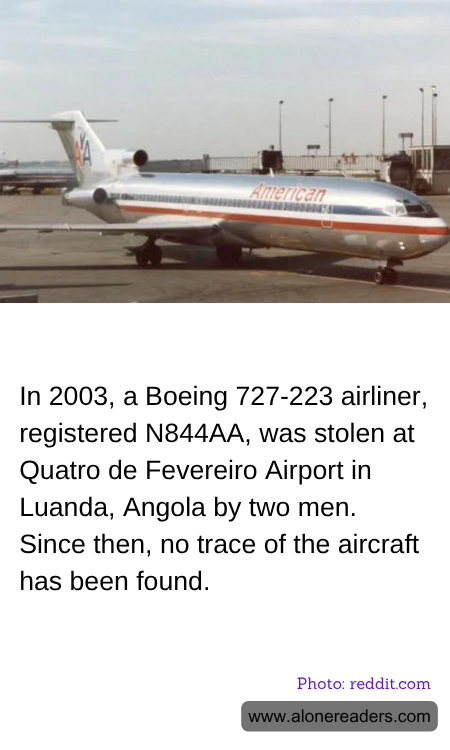
In the annals of aviation history, few mysteries are as perplexing as the disappearance of a Boeing 727-223 airliner, registered N844AA, from Quatro de Fevereiro Airport in Luanda, Angola, in 2003. This incident, involving the audacious theft of a commercial jetliner, has intrigued aviation enthusiasts and investigators alike for two decades, yet remains unsolved.
On May 25, 2003, the Boeing 727-223, previously operated by American Airlines, vanished under circumstances that continue to baffle experts. The aircraft was being prepared for a new lease and was undergoing modifications to be converted into a cargo plane. On that fateful day, two men, one of whom was Ben Charles Padilla, an American pilot and aircraft mechanic, boarded the plane. The other individual was a Congolese mechanic whose identity remains less documented. Without any formal flight plan or clearance, the aircraft taxied erratically onto the runway and took off into the evening sky, never to be seen again.
The disappearance of N844AA sparked an international search effort. The United States, concerned about the potential use of the aircraft for illicit activities, launched a global investigation involving multiple agencies, including the FBI and the CIA. Despite extensive efforts, no concrete evidence has emerged to explain the aircraft's fate. Theories abound, ranging from the plane being dismantled for parts to it being used for smuggling operations. However, none of these speculations have been substantiated with definitive proof.
The case of the missing Boeing 727 is particularly intriguing due to the sheer size of the aircraft. Unlike smaller planes, a Boeing 727 is a large, commercial airliner, making its disappearance without a trace all the more puzzling. The aircraft's absence from radar and the lack of any distress signals or communication further deepen the mystery. Over the years, sporadic reports have surfaced claiming sightings of the plane in various remote locations, but none have been verified.
This incident has not only captivated the public's imagination but also highlighted vulnerabilities in aviation security, particularly in regions with less stringent oversight. The theft of such a significant aircraft without detection underscores the challenges faced by international aviation authorities in ensuring the security of air travel.
As the years pass, the mystery of the stolen Boeing 727-223 continues to linger, a testament to the complexities and enigmas that sometimes accompany human endeavors. While the world may never know the true fate of N844AA, its story remains a compelling chapter in the history of aviation, reminding us of the vastness of our world and the secrets it still holds.
