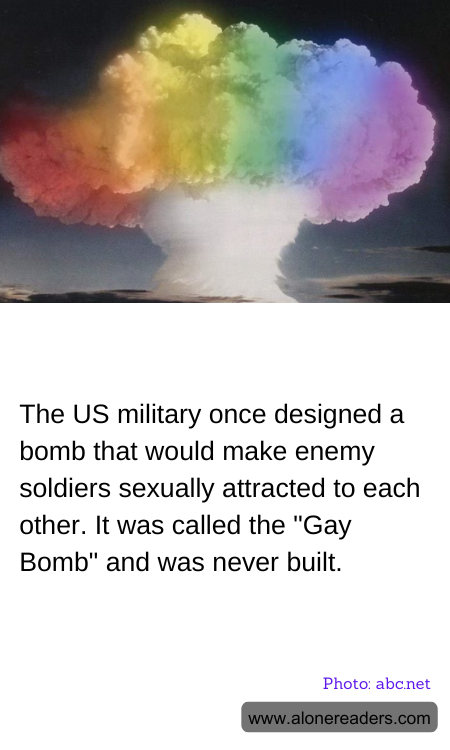
In the annals of military history, there are numerous examples of unconventional and sometimes bizarre strategies devised in the pursuit of gaining an advantage over adversaries. Among these, one of the most unusual proposals was the so-called "Gay Bomb," a non-lethal chemical weapon concept that emerged from the United States military's research in the 1990s. Although it was never developed or deployed, the idea remains a curious footnote in the history of military innovation.
The concept of the "Gay Bomb" originated from a 1994 proposal by the U.S. Air Force's Wright Laboratory in Ohio. The idea was to create a chemical weapon that could be dispersed over enemy forces, causing them to become sexually attracted to one another. The underlying theory was that such a reaction would disrupt unit cohesion and morale, rendering the enemy less effective in combat. The proposal suggested that the chemical would target the hormones responsible for sexual attraction, leading to a temporary but profound change in behavior.
Despite the seemingly outlandish nature of the idea, the proposal was part of a broader exploration of non-lethal weapons that could incapacitate enemy forces without causing permanent harm. The "Gay Bomb" was one of several concepts considered under a $7.5 million budget request for non-lethal chemical weapons research. Other ideas included chemicals that could attract swarms of stinging insects or cause severe and uncontrollable flatulence among enemy troops.
The "Gay Bomb" proposal never advanced beyond the conceptual stage. It was ultimately deemed impractical and ethically questionable, raising concerns about the potential violation of international treaties that prohibit the use of chemical weapons. The idea also faced criticism for its reliance on stereotypes and assumptions about human sexuality, which are far more complex than the proposal suggested.
In 2007, the existence of the "Gay Bomb" proposal became widely known when it was revealed through a Freedom of Information Act request by the Sunshine Project, a watchdog group focused on biological and chemical weapons. The revelation sparked a mix of amusement and outrage, highlighting the sometimes absurd lengths to which military planners might go in their quest for strategic advantage.
While the "Gay Bomb" was never built, its story serves as a reminder of the importance of ethical considerations in military research and development. It underscores the need for oversight and accountability in the pursuit of new technologies, ensuring that the quest for innovation does not lead to proposals that are not only impractical but also potentially harmful or offensive.
In the end, the "Gay Bomb" remains a peculiar chapter in military history, a testament to the creativity and, at times, the folly of human ingenuity. It stands as a cautionary tale about the boundaries of scientific exploration and the ethical responsibilities that come with the power to innovate.
