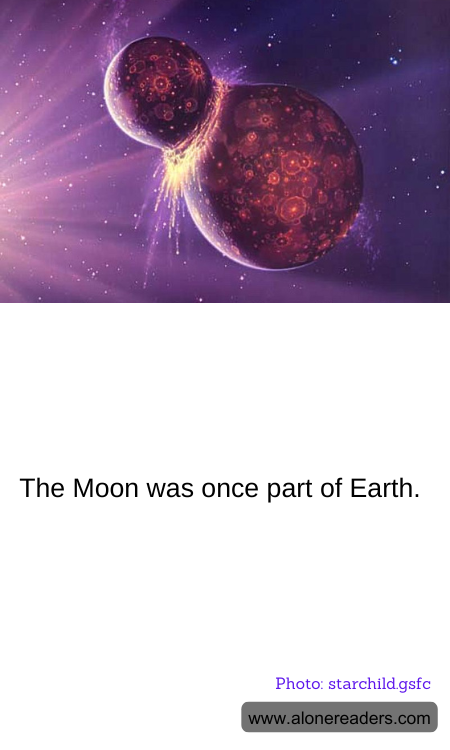
The Moon, our closest celestial neighbor, has long fascinated humanity with its serene beauty and mysterious presence in the night sky. While it has been the subject of countless myths and scientific studies, one of the most intriguing theories about the Moon is that it was once part of Earth. This idea, known as the giant impact hypothesis, suggests that the Moon was formed from the debris left over after a colossal collision between the early Earth and a Mars-sized body, often referred to as Theia.
This hypothesis emerged as scientists sought to explain the similarities and differences between the Earth and the Moon. The Moon's composition is remarkably similar to that of Earth's mantle, suggesting a shared origin. However, the Moon lacks significant amounts of volatile elements, which are abundant on Earth. This discrepancy led researchers to propose that a massive impact could have vaporized these elements, leaving behind the Moon as we know it today.
The giant impact hypothesis posits that around 4.5 billion years ago, during the chaotic early days of the solar system, Theia collided with the young Earth. The immense energy from this impact would have caused a significant portion of Earth's outer layers to be ejected into space. Over time, this debris coalesced under the influence of gravity, eventually forming the Moon. This theory not only explains the Moon's composition but also its relatively large size compared to other moons in the solar system.
Further evidence supporting this theory comes from the analysis of lunar rocks brought back by the Apollo missions. These samples reveal isotopic compositions that closely match those of Earth's rocks, reinforcing the idea of a shared origin. Additionally, computer simulations of the giant impact scenario have shown that such a collision could indeed produce a Moon with the characteristics we observe today.
While the giant impact hypothesis is widely accepted, it is not without its challenges. Some scientists question the specifics of the collision, such as the size and velocity of Theia, and how these factors would have influenced the resulting Moon. Ongoing research and advancements in technology continue to refine our understanding of this cosmic event, offering new insights into the early history of our planet and its satellite.
The notion that the Moon was once part of Earth adds a profound layer to our understanding of the solar system's history. It highlights the dynamic and often violent processes that shaped the planets and their moons. As we continue to explore the Moon and study its origins, we not only learn more about our celestial companion but also gain a deeper appreciation for the interconnectedness of the universe. This theory reminds us that the Moon is not just a distant object in the sky but a piece of our own planet's history, forever orbiting as a testament to the forces that forged our world.
