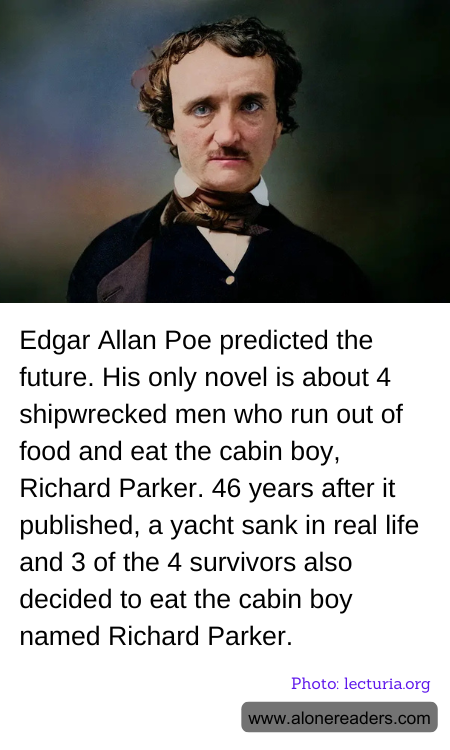
Edgar Allan Poe, renowned for his macabre and mysterious tales, has long been celebrated for his contributions to the literary world. However, one of the most intriguing aspects of his legacy is the uncanny prediction found in his only novel, "The Narrative of Arthur Gordon Pym of Nantucket." Published in 1838, this novel tells the harrowing story of four shipwrecked men who, in a desperate bid for survival, resort to cannibalism, ultimately consuming the cabin boy, Richard Parker. Astonishingly, 46 years later, a real-life maritime tragedy mirrored Poe's fictional account in a chilling coincidence that continues to captivate the imagination.
In Poe's novel, the protagonist, Arthur Gordon Pym, embarks on a perilous sea voyage that quickly spirals into chaos. After a series of misadventures, Pym and his companions find themselves adrift in the vast ocean, their provisions depleted. Faced with the grim reality of starvation, they draw lots to determine who among them will be sacrificed for the survival of the others. The unfortunate victim is the cabin boy, Richard Parker, whose fate is sealed in a moment of desperation.
Fast forward to 1884, when the yacht Mignonette set sail from England to Australia. The vessel was ill-suited for such a long journey, and disaster struck when it sank in the South Atlantic. The four survivors, including a cabin boy named Richard Parker, were left stranded in a lifeboat with scant supplies. As days turned into weeks, the men faced the same dire circumstances as Poe's fictional characters. In a haunting echo of the novel, they too resorted to cannibalism, ultimately deciding to sacrifice and consume the cabin boy, Richard Parker, to stave off starvation.
This eerie parallel between fiction and reality has sparked endless debate and fascination. Was it mere coincidence, or did Poe possess an uncanny ability to foresee future events? While some may argue that the similarities are purely coincidental, others are drawn to the notion of Poe as a literary prophet, capable of glimpsing into the future through his vivid imagination.
The story of Richard Parker, both in fiction and reality, serves as a poignant reminder of the thin line between survival and morality. It challenges readers to ponder the ethical dilemmas faced by those in life-or-death situations and the lengths to which humans will go when pushed to the brink. Poe's novel, with its dark themes and unsettling foresight, continues to captivate audiences, inviting them to explore the depths of human nature and the mysteries of fate.
In the end, whether Edgar Allan Poe predicted the future or simply crafted a tale that coincidentally mirrored real-life events, the story of Richard Parker remains a testament to the enduring power of literature to reflect the complexities of the human condition. It is a narrative that transcends time, reminding us of the unpredictable twists of fate and the enduring enigma of the human spirit.
