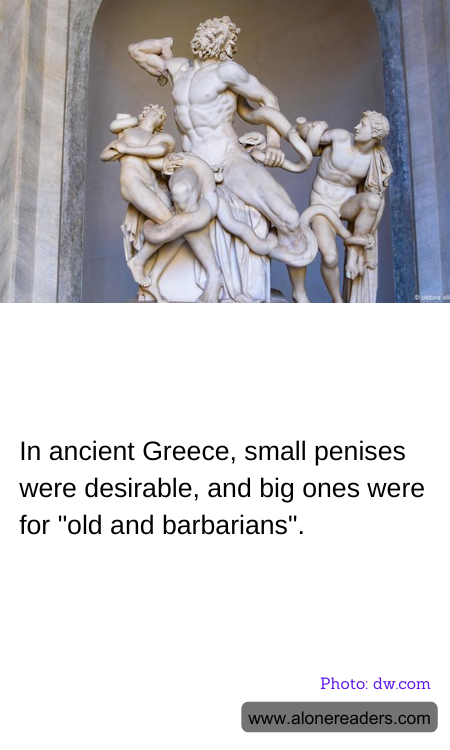
In the realm of ancient Greece, a civilization renowned for its profound contributions to art, philosophy, and politics, there existed a fascinating perspective on male beauty that starkly contrasts with contemporary ideals. In this ancient society, the perception of male genitalia was imbued with cultural significance, where smaller penises were considered desirable and emblematic of civility, while larger ones were often associated with the uncultured and the barbaric.
This intriguing cultural norm is vividly illustrated in Greek art and literature. Statues and sculptures from the period frequently depict male figures with modestly sized genitalia, a feature that was celebrated as a symbol of self-control, intelligence, and rationality. The Greeks placed a high value on moderation and balance, virtues that were believed to be reflected in the physical form. A smaller penis was seen as a sign of a man who was not ruled by base instincts or excessive lust, but rather by reason and virtue.
In contrast, larger penises were often depicted in satirical contexts or associated with figures considered to be less civilized. For example, in Greek comedies and plays, characters with exaggerated genitalia were typically portrayed as foolish or brutish, serving as a comedic device to highlight their lack of sophistication. This association extended to the portrayal of foreigners or "barbarians," who were often depicted with larger genitalia to emphasize their perceived lack of refinement and self-discipline.
The Greek philosopher Aristotle and playwright Aristophanes both touched upon these themes, reinforcing the notion that a smaller penis was a mark of a well-bred and cultured individual. This perspective was not merely an aesthetic preference but was deeply intertwined with the Greek ideals of masculinity and virtue. The emphasis on moderation and self-control was a reflection of the broader Greek ethos, which prized the harmony between body and mind.
This cultural viewpoint offers a fascinating insight into how ideals of beauty and masculinity can vary dramatically across different societies and historical periods. It challenges modern assumptions and highlights the fluidity of beauty standards, reminding us that what is considered desirable or admirable is often shaped by cultural narratives and values.
In examining these ancient beliefs, we gain a deeper understanding of how the Greeks viewed the human form and the qualities they esteemed. It serves as a reminder of the diverse ways in which societies construct ideals of beauty and the complex interplay between physical appearance and cultural values. As we reflect on these ancient perspectives, we are encouraged to consider the broader implications of how cultural norms shape our understanding of beauty and identity.
