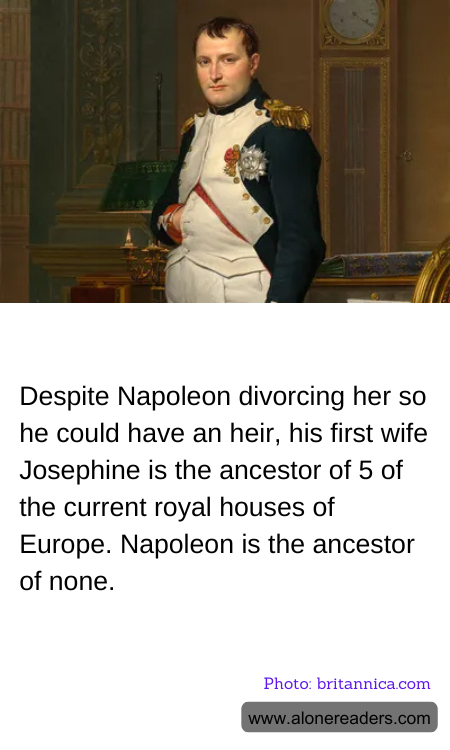
In the annals of European history, few figures loom as large as Napoleon Bonaparte, the ambitious Corsican who rose to become Emperor of the French. Yet, despite his towering presence on the historical stage, Napoleon's personal legacy is surprisingly absent from the royal genealogies of modern Europe. In contrast, his first wife, Joséphine de Beauharnais, has left an indelible mark on the continent's royal lineage, being an ancestor to five of the current royal houses of Europe.
Napoleon's marriage to Joséphine was one of both passion and political necessity. Their union, however, was marred by the absence of an heir, a situation that ultimately led to their divorce in 1810. Napoleon, driven by the desire to establish a dynasty, remarried Marie Louise of Austria, hoping to secure his lineage. Although this second marriage produced a son, Napoleon II, the young heir's life was short and politically inconsequential, leaving no descendants to carry on the Bonaparte name in the royal courts of Europe.
In stark contrast, Joséphine's legacy flourished through her children from her first marriage to Alexandre de Beauharnais. Her daughter, Hortense, married Louis Bonaparte, Napoleon's brother, and became the mother of Napoleon III, the last Emperor of the French. More significantly, Joséphine's son, Eugène de Beauharnais, married Princess Augusta of Bavaria, establishing a lineage that would intertwine with several European royal families.
Through Eugène's descendants, Joséphine's bloodline spread across the continent. Her progeny married into the royal families of Sweden, Norway, Denmark, Belgium, and Luxembourg. Today, Joséphine's descendants sit on the thrones of these nations, a testament to her enduring influence. The Swedish royal family, for instance, traces its lineage back to Joséphine through her grandson, King Oscar I of Sweden and Norway. Similarly, the Belgian and Danish royal families count her among their ancestors, underscoring her lasting impact on European aristocracy.
The irony of this genealogical twist is not lost on historians and enthusiasts alike. While Napoleon's dreams of a dynastic empire faded with his downfall, Joséphine's legacy quietly took root and flourished across Europe. Her story serves as a poignant reminder of the unpredictable nature of history and the enduring power of familial connections.
In a world where power and legacy are often measured by tangible achievements, Joséphine's story is a testament to the subtle yet profound influence of lineage. Her descendants continue to shape the cultural and political landscapes of Europe, a legacy that Napoleon, despite his grand ambitions, could not secure for himself. This fascinating historical footnote highlights the unpredictable paths of legacy and the enduring impact of personal relationships on the broader tapestry of history.
