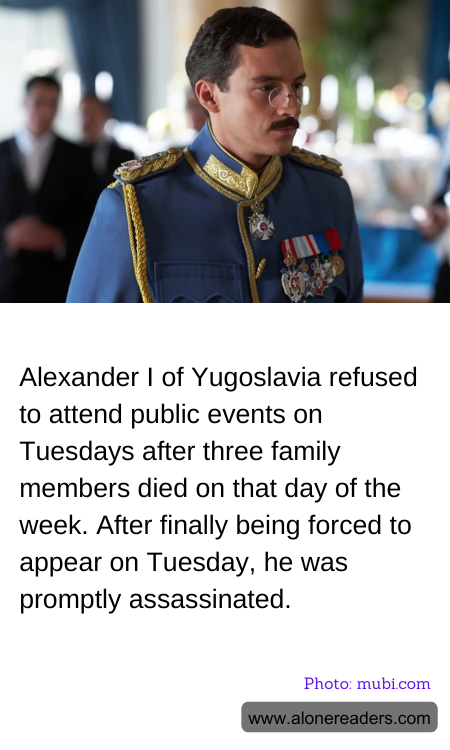
Alexander I of Yugoslavia, a monarch whose reign was marked by both political turbulence and personal tragedy, is remembered not only for his efforts to unify his country but also for his peculiar superstition regarding Tuesdays. This unusual aversion stemmed from a series of personal losses that deeply affected him. Three of his family members had died on a Tuesday, a pattern that left an indelible mark on the king's psyche. As a result, Alexander developed a profound fear of the day, leading him to avoid public appearances on Tuesdays whenever possible.
This superstition was not merely a personal quirk but a reflection of the king's deep-seated belief in the ominous nature of the day. His avoidance of public events on Tuesdays became well-known, and it was a practice he adhered to strictly. However, the demands of leadership and the pressures of statecraft sometimes necessitated exceptions to his rule. Despite his best efforts to steer clear of public engagements on this fateful day, circumstances eventually forced him to break his self-imposed restriction.
On October 9, 1934, a Tuesday, King Alexander I was compelled to make a public appearance in Marseille, France. The visit was part of a diplomatic mission aimed at strengthening ties between Yugoslavia and France. Despite his apprehensions, the king embarked on the journey, perhaps hoping that this time, the day would pass without incident. Tragically, his fears were realized when he was assassinated during a motorcade procession through the streets of Marseille. The assassin, a member of a radical group opposed to Alexander's policies, struck swiftly, ending the king's life and fulfilling the grim prophecy that had haunted him for years.
The assassination of King Alexander I was a significant event in European history, not only because it marked the end of his reign but also because it underscored the volatile political climate of the time. His death sent shockwaves through Yugoslavia and beyond, highlighting the deep-seated tensions and divisions that plagued the region. The king's assassination on a Tuesday added a layer of tragic irony to his story, cementing his legacy as a ruler whose life and death were inextricably linked to the day he so feared.
In the years that followed, the story of Alexander I's superstition and his untimely demise became a poignant reminder of the unpredictable nature of fate. It serves as a testament to the human tendency to seek patterns and meaning in the face of tragedy, as well as the enduring impact of personal beliefs on public life. King Alexander I's life and death continue to captivate historians and the public alike, offering a glimpse into the complexities of leadership and the enduring power of superstition.
