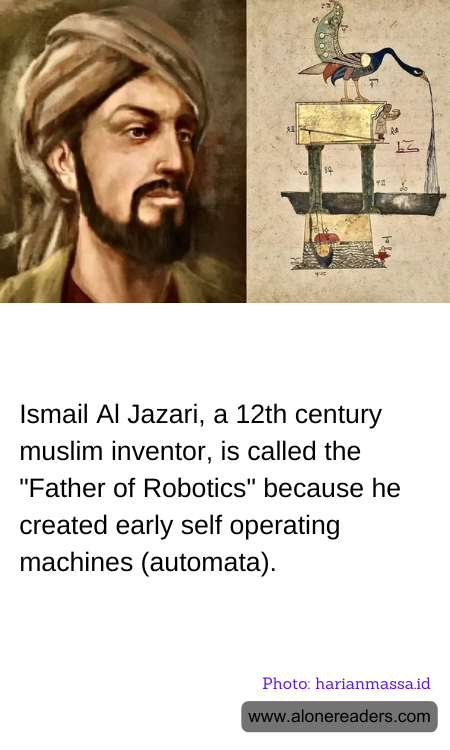
In the annals of history, the name Ismail Al Jazari stands out as a beacon of innovation and creativity. A 12th-century Muslim inventor, Al Jazari is often hailed as the "Father of Robotics" due to his groundbreaking work in creating early self-operating machines, known as automata. His contributions laid the foundation for modern robotics and engineering, showcasing the ingenuity and scientific prowess of the Islamic Golden Age.
Born in 1136 in the region that is now southeastern Turkey, Al Jazari served as a chief engineer at the Artuklu Palace, where he dedicated his life to the study and creation of mechanical devices. His most renowned work, "The Book of Knowledge of Ingenious Mechanical Devices," written in 1206, is a comprehensive compilation of his inventions and mechanical designs. This manuscript not only illustrates his mechanical genius but also serves as an invaluable resource for understanding the technological advancements of his time.
Al Jazari's automata were marvels of engineering, blending artistry with functionality. Among his most famous creations was the "Elephant Clock," a complex timekeeping device that incorporated elements from various cultures, including Greek, Indian, and Islamic traditions. This clock was not only a testament to his engineering skills but also a symbol of the cultural and scientific exchanges that characterized the medieval Islamic world. The Elephant Clock featured a water-powered mechanism that animated figures, creating a spectacle that was both educational and entertaining.
Another notable invention was his series of water-raising machines, which demonstrated his understanding of hydraulics and mechanical engineering. These devices were designed to lift water for irrigation and other purposes, showcasing practical applications of his inventions in everyday life. Al Jazari's work in this area laid the groundwork for future developments in hydraulic engineering and automation.
Al Jazari's automata were not merely mechanical curiosities; they were sophisticated machines that demonstrated principles of robotics long before the term was even coined. His use of gears, pulleys, and levers to create self-operating devices foreshadowed the development of modern robotics and automation technologies. His inventions were characterized by their intricate designs and the seamless integration of form and function, reflecting a deep understanding of both mechanics and aesthetics.
The legacy of Ismail Al Jazari extends beyond his mechanical inventions. His work exemplifies the spirit of inquiry and innovation that defined the Islamic Golden Age, a period marked by significant advancements in science, technology, and culture. Al Jazari's contributions continue to inspire engineers and inventors around the world, reminding us of the enduring impact of creativity and ingenuity.
In celebrating Al Jazari's achievements, we acknowledge the rich history of scientific exploration and the diverse contributions that have shaped our modern world. His pioneering work in automata not only earned him the title of the "Father of Robotics" but also secured his place in history as a visionary whose ideas transcended the boundaries of time and culture.
