In the early 19th century, the lumber industry was a labor-intensive sector, heavily reliant on manual tools and techniques. Among these tools was the traditional two-man pit saw, which required significant physical effort and time, as only half of the sawing motion actually contributed to cutting the wood. It was during this period of inefficiency that Tabitha Babbitt, a Shaker woman from Massachusetts, made a groundbreaking contribution that would forever change the industry.
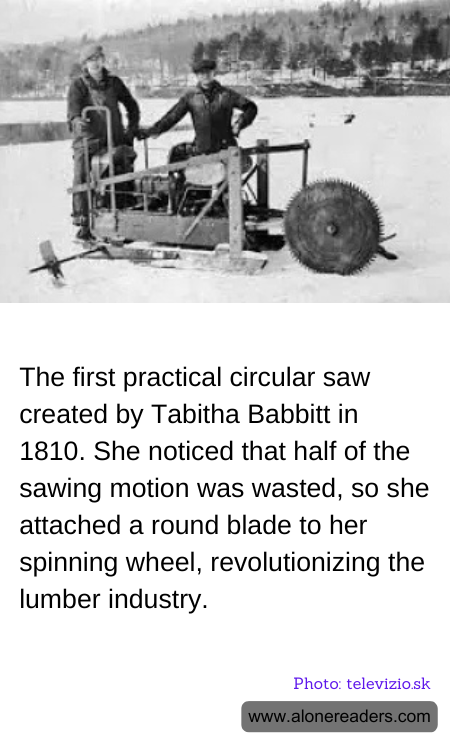
Tabitha Babbitt was not only a skilled weaver but also an astute observer of her surroundings. In 1810, she noticed the inefficiency of the traditional sawing method and set out to find a solution. Her innovative spirit led her to adapt the spinning wheel, a tool she was familiar with, to create the first practical circular saw. By attaching a round blade to her spinning wheel, Babbitt introduced a continuous cutting motion, which drastically reduced the physical labor required and increased the efficiency of the sawing process.
The circular saw was revolutionary because it utilized the entire motion of the blade, unlike the back-and-forth motion of the pit saw, which wasted energy on the return stroke. Babbitt’s invention allowed for a smoother, faster, and more precise cut, making it an invaluable tool in the lumber industry. Her design laid the foundation for the modern circular saws used today, which are essential in both industrial and home settings.
Despite the significance of her invention, Babbitt never sought a patent for her circular saw. As a member of the Shaker community, she adhered to their principles of communal ownership and shared innovation. The Shakers believed that inventions should benefit society as a whole, rather than serve individual interests. This ethos allowed Babbitt’s invention to spread and be adapted by others, further cementing its place in the history of industrial advancements.
Tabitha Babbitt’s contribution to the lumber industry is a testament to the power of observation and innovation. Her circular saw not only revolutionized the way wood was processed but also paved the way for future technological advancements in various fields. Her story serves as an inspiring reminder that ingenuity can come from the most unexpected places and that even small innovations can have a profound impact on the world.
Today, Babbitt’s legacy lives on in the countless circular saws used around the globe, a fitting tribute to a woman whose keen insight and creativity transformed an entire industry. Her invention remains a symbol of practical problem-solving and the enduring influence of those who dare to think differently.
