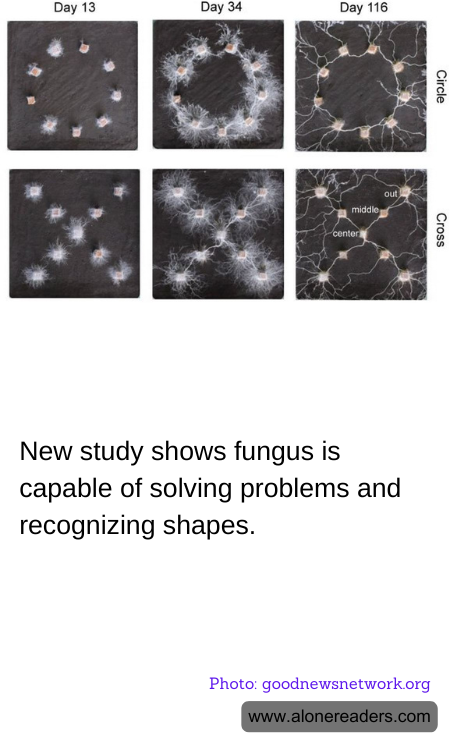
In a groundbreaking study that challenges our understanding of intelligence and problem-solving in the natural world, researchers have discovered that certain fungi possess the remarkable ability to solve problems and recognize shapes. This revelation not only broadens our comprehension of fungal capabilities but also opens up new avenues for exploring the cognitive potential of non-animal organisms.
The study, conducted by a team of biologists and mycologists, focused on the slime mold *Physarum polycephalum*, a single-celled organism that has long intrigued scientists with its complex behavior despite lacking a nervous system. Researchers designed a series of experiments to test the slime mold's ability to navigate mazes and recognize patterns. Remarkably, the fungi demonstrated an ability to solve mazes by finding the shortest path to a food source, a task that requires a form of spatial awareness and decision-making.
Even more astonishing was the fungi's ability to recognize and respond to shapes. In one experiment, researchers placed food sources in the shape of geometric patterns. The slime mold was able to adjust its growth pattern to match the shape of the food arrangement, suggesting a level of shape recognition previously thought impossible for such a simple organism. This ability to adapt and optimize its growth strategy indicates a form of primitive intelligence that challenges traditional definitions of cognition.
The implications of these findings are profound. They suggest that intelligence and problem-solving are not exclusive to animals with complex nervous systems. Instead, these capabilities may be more widespread in the natural world than previously believed. This challenges the anthropocentric view of intelligence and encourages a broader perspective on how life forms interact with their environment.
Furthermore, the study's results could have practical applications in fields such as bio-computing and robotics. The efficient problem-solving strategies of fungi could inspire new algorithms for network optimization and autonomous systems. By mimicking the growth patterns and decision-making processes of slime molds, engineers could develop more efficient ways to design transportation networks, optimize resource distribution, and even create self-healing materials.
As researchers continue to explore the cognitive abilities of fungi, the study serves as a reminder of the complexity and diversity of life on Earth. It underscores the importance of studying all forms of life, no matter how simple they may seem, to gain a deeper understanding of the mechanisms that drive intelligence and adaptation. This newfound appreciation for fungal capabilities not only enriches our scientific knowledge but also inspires a sense of wonder about the hidden intelligence that exists in the natural world.
