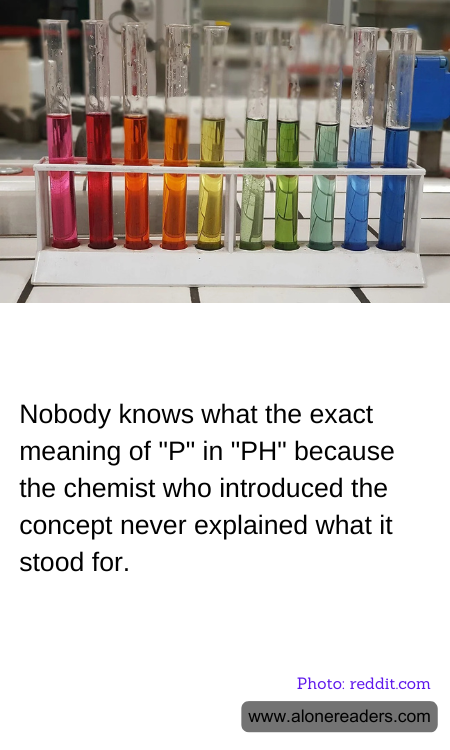
In the world of chemistry, the pH scale is a fundamental concept used to measure the acidity or alkalinity of a solution. Despite its widespread use, the origin of the term "pH" remains shrouded in mystery, particularly the meaning of the letter "P." This enigma traces back to the early 20th century when the Danish chemist Søren Peder Lauritz Sørensen introduced the concept. While Sørensen's work laid the groundwork for modern chemistry, he never explicitly clarified what the "P" in "pH" stood for, leaving scientists and historians to speculate.
Sørensen developed the pH scale in 1909 while working at the Carlsberg Laboratory in Copenhagen. His primary goal was to create a simple way to express the concentration of hydrogen ions in a solution, which is crucial for understanding chemical reactions. The scale he devised ranges from 0 to 14, with lower numbers indicating higher acidity and higher numbers indicating greater alkalinity. The "H" in "pH" clearly stands for hydrogen, but the "P" has been the subject of much debate.
Several theories have been proposed over the years regarding the meaning of "P." One popular hypothesis is that it stands for "potenz," a German word meaning "power" or "potential." This interpretation aligns with the mathematical nature of the pH scale, which is based on the negative logarithm of the hydrogen ion concentration. Another theory suggests that "P" could stand for "pondus," a Latin word meaning "weight," reflecting the scale's role in measuring the "weight" or concentration of hydrogen ions. Yet another possibility is that "P" simply stands for "potential," as in the potential of hydrogen ions to influence a solution's acidity.
Despite these theories, no definitive evidence has emerged to confirm any particular interpretation. Sørensen himself never documented the reasoning behind his choice of "P," and his silence on the matter has only fueled the intrigue. Some historians suggest that the ambiguity may have been intentional, allowing the term to be flexible and adaptable as the field of chemistry evolved.
The mystery of the "P" in "pH" serves as a reminder of the complexities and nuances inherent in scientific discovery. It highlights how even the most fundamental concepts can have origins that are not entirely clear, reflecting the iterative and sometimes enigmatic nature of scientific progress. For students and enthusiasts of chemistry, this unsolved puzzle adds an element of curiosity and wonder to the study of acids and bases.
In the end, while the exact meaning of "P" in "pH" may remain elusive, the scale itself continues to be an indispensable tool in chemistry, biology, and environmental science. Its ability to provide a simple yet powerful measure of acidity and alkalinity ensures that it remains a cornerstone of scientific education and research. As we continue to explore the natural world, the pH scale stands as a testament to the enduring legacy of Søren Sørensen's work, even if one small piece of the puzzle remains unsolved.
