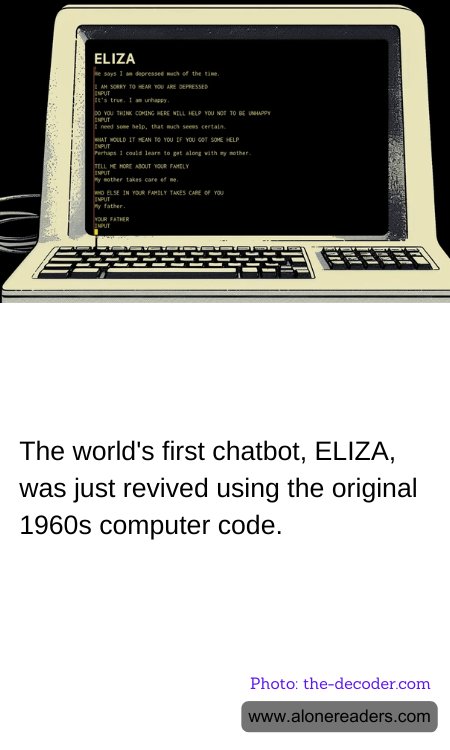
In a remarkable fusion of history and technology, the world’s first chatbot, ELIZA, has been revived using its original 1960s computer code. This pioneering program, which laid the groundwork for modern conversational AI, was initially developed by Joseph Weizenbaum at the Massachusetts Institute of Technology (MIT) between 1964 and 1966. ELIZA was designed to simulate conversation by using a script that mimicked a psychotherapist, engaging users in dialogue by rephrasing their inputs as questions. This simple yet effective technique captivated users and sparked discussions about the potential and limitations of artificial intelligence.
The revival of ELIZA is a testament to the enduring fascination with early computing and the foundational technologies that have shaped today’s digital landscape. By using the original code, enthusiasts and historians have managed to bring ELIZA back to life, allowing a new generation to experience firsthand the charm and ingenuity of early AI development. This project not only serves as a nostalgic journey into the past but also provides valuable insights into the evolution of human-computer interaction.
ELIZA’s design was groundbreaking for its time, operating on the limited computing resources available in the 1960s. It ran on the IBM 7094, a mainframe computer that was one of the most powerful of its era. Despite its simplicity, ELIZA was able to create the illusion of understanding, prompting users to engage in surprisingly meaningful conversations. This was achieved through pattern matching and substitution methodology, which, although rudimentary by today’s standards, was revolutionary in demonstrating the potential of machines to process natural language.
The revival project has sparked renewed interest in the history of artificial intelligence, highlighting the significant strides made since ELIZA’s inception. Today’s chatbots, powered by advanced machine learning algorithms and vast datasets, are capable of understanding and generating human-like responses with remarkable accuracy. However, ELIZA’s simplicity serves as a reminder of the humble beginnings of AI and the visionaries who dared to imagine a future where machines could engage in human-like dialogue.
For many, interacting with ELIZA today is both an educational experience and a nostalgic trip down memory lane. It offers a unique opportunity to appreciate the ingenuity of early computer scientists and the foundational work that has paved the way for modern AI technologies. As we continue to push the boundaries of what artificial intelligence can achieve, revisiting ELIZA reminds us of the importance of innovation, curiosity, and the relentless pursuit of knowledge that drives technological advancement.
In conclusion, the revival of ELIZA using its original 1960s code is more than just a nod to the past; it is a celebration of the pioneering spirit that continues to inspire the field of artificial intelligence. By reconnecting with this iconic piece of computing history, we gain a deeper appreciation for the journey from simple pattern-matching scripts to the sophisticated AI systems that are now integral to our daily lives.
