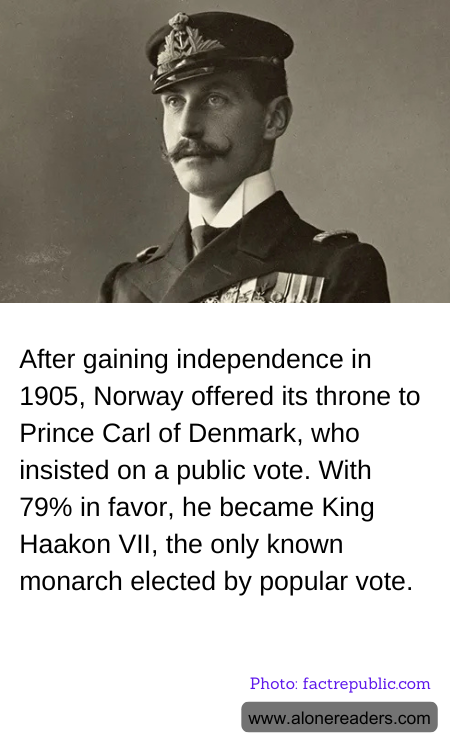
In the early 20th century, Norway embarked on a journey to establish its identity as an independent nation. After dissolving its union with Sweden in 1905, Norway faced the critical decision of selecting a monarch to symbolize its newfound sovereignty. The choice fell upon Prince Carl of Denmark, a member of the Danish royal family, who was offered the throne. However, in a remarkable display of democratic principles, Prince Carl insisted that the Norwegian people should have a say in their future king. This led to a public referendum, a unique event in the annals of monarchy, where the people were given the power to elect their monarch.
The referendum was held in November 1905, and the results were overwhelmingly in favor of Prince Carl, with 79% of the voters supporting his ascension to the throne. This decisive vote not only affirmed the people's choice but also set a precedent for the democratic values that would come to define modern Norway. Upon accepting the throne, Prince Carl adopted the name King Haakon VII, a nod to Norway's medieval kings, thus linking the new monarchy to the country's rich historical legacy.
King Haakon VII's reign marked a significant era in Norwegian history. His election by popular vote was a testament to the country's commitment to democracy and self-determination. As a monarch, King Haakon VII was deeply respected and admired for his dedication to the nation and its people. He played a crucial role during World War II, when Norway was occupied by Nazi Germany. His leadership and steadfastness during this tumultuous period earned him a revered place in the hearts of Norwegians.
The story of King Haakon VII is not just about a royal figurehead but also about the values and aspirations of a nation. His election by popular vote remains a singular event in the history of monarchies worldwide, highlighting Norway's unique approach to governance and its emphasis on the will of the people. This historical moment continues to be a source of pride for Norwegians, symbolizing their commitment to democracy and the enduring bond between the monarchy and the populace.
Today, King Haakon VII is remembered not only as a monarch but as a symbol of unity and resilience. His legacy is a reminder of the power of democratic principles and the importance of national identity. The election of a king by popular vote in 1905 stands as a remarkable chapter in Norway's history, illustrating the nation's journey towards self-determination and the enduring values that continue to shape its society.
