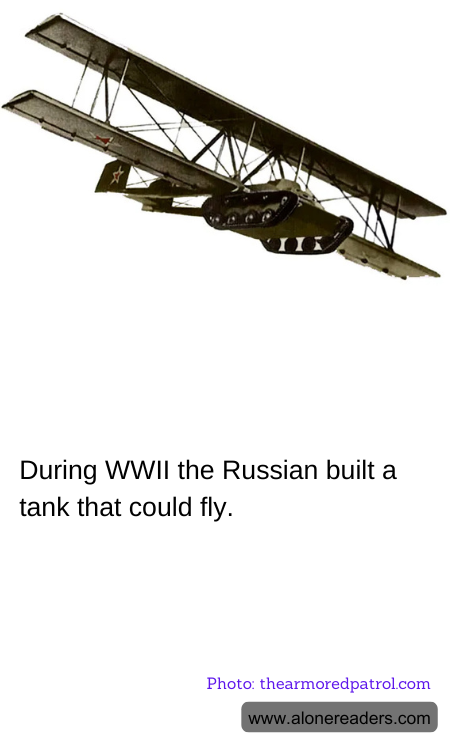
During World War II, the relentless pursuit of innovation led to some of the most extraordinary and unconventional military inventions. Among these was the Soviet Union's ambitious attempt to create a flying tank, a concept that, while seemingly outlandish, was rooted in strategic necessity and creative engineering. This remarkable endeavor was embodied in the Antonov A-40, also known as the "Krylya Tanka" or "Tank Wings."
The idea of a flying tank was born out of the need to provide rapid and flexible support to ground forces, particularly in areas where traditional transport methods were impractical. The Soviet Union, facing the vast and often inhospitable terrains of Eastern Europe, saw the potential in combining the firepower and armor of a tank with the mobility of an aircraft. The concept was to airlift tanks directly into battle zones, bypassing obstacles and delivering immediate armored support to troops.
The Antonov A-40 was designed by Oleg Antonov, a visionary aircraft engineer. The project involved attaching large biplane wings and a twin tail to a T-60 light tank, effectively transforming it into a glider. The tank's turret and armament remained intact, ensuring that once it landed, it could immediately engage in combat. The wings were detachable, allowing the tank to revert to its original form after landing.
In theory, the A-40 would be towed into the air by a larger aircraft, such as a bomber, and released near the battlefield. The tank would then glide to the ground, land on its tracks, and proceed to support ground operations. However, the practical challenges of this ambitious design quickly became apparent. The weight of the tank, even a light one like the T-60, posed significant difficulties. The towing aircraft needed to be exceptionally powerful to lift the combined weight of the tank and its glider apparatus.
A test flight was conducted in 1942, with a T-60 tank fitted with the glider wings. The towing aircraft, a Petlyakov Pe-8 bomber, struggled to maintain altitude and speed, ultimately forcing the test to be aborted. The tank was released prematurely, but it managed to glide safely to the ground, demonstrating the concept's potential, albeit with limitations.
Despite the ingenuity behind the A-40, the project was ultimately abandoned. The technological and logistical challenges, coupled with the pressing demands of the war, made further development impractical. However, the flying tank remains a fascinating chapter in military history, showcasing the lengths to which engineers and strategists were willing to go in their quest for battlefield superiority.
The legacy of the Antonov A-40 is a testament to human creativity and the relentless drive to innovate, even in the face of seemingly insurmountable obstacles. While it never saw combat, the flying tank concept continues to capture the imagination, serving as a reminder of the extraordinary ideas that emerge during times of great challenge and change.
