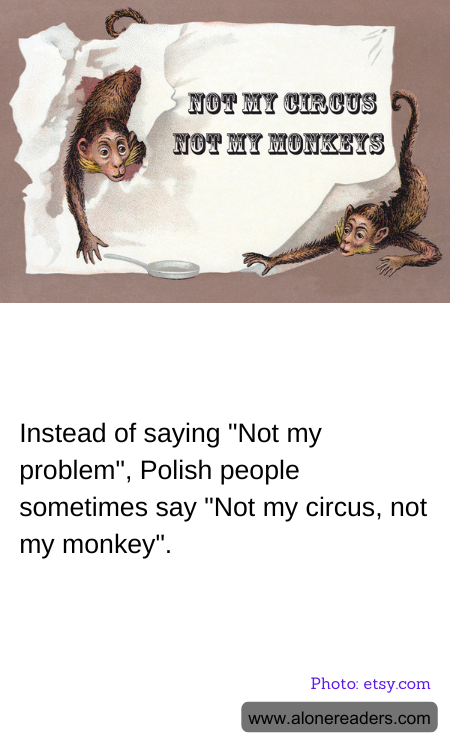
More About This Card
In the rich tapestry of global idioms, few are as colorful and evocative as the Polish saying, "Nie mój cyrk, nie moje malpy," which translates to "Not my circus, not my monkey." This phrase, used to express detachment from a problem or situation, offers a vivid metaphor that captures the essence of personal boundaries and the importance of focusing on one's own responsibilities.
The idiom is a delightful example of how language can reflect cultural nuances and attitudes. In Poland, as in many cultures, there is a recognition of the chaos and unpredictability that life can bring. The imagery of a circus, with its bustling activity and unpredictable performers, serves as a perfect metaphor for the complexities and challenges that people face. By declaring "Not my circus, not my monkey," an individual is effectively saying that the chaos in question is not theirs to manage, thus setting a clear boundary between what they are responsible for and what they are not.
This expression is not only a testament to the Polish sense of humor but also a practical tool for maintaining mental health and personal well-being. In a world where people are often overwhelmed by the demands of work, family, and social obligations, the ability to recognize and articulate what is and isn't one's responsibility is crucial. By using this idiom, individuals can politely and humorously decline involvement in situations that do not concern them, thereby preserving their energy and focus for matters that truly require their attention.
Interestingly, the phrase has gained popularity beyond Poland, resonating with people from various cultures who appreciate its straightforward wisdom. In an increasingly interconnected world, where the lines between personal and professional life can often blur, the need to establish clear boundaries is more important than ever. The idiom serves as a gentle reminder that not every problem is ours to solve, and that it is perfectly acceptable to step back from situations that do not directly impact us.
Moreover, the phrase underscores a universal truth about human nature: the tendency to become entangled in issues that are not our own. Whether it's meddling in a friend's personal affairs or taking on unnecessary stress at work, people often find themselves caught up in the proverbial circus. By adopting the mindset encapsulated in this idiom, individuals can cultivate a healthier approach to problem-solving and interpersonal relationships.
In conclusion, "Not my circus, not my monkey" is more than just a quirky saying; it is a valuable life lesson wrapped in a charming metaphor. It encourages people to recognize their limits, prioritize their own well-being, and approach life's challenges with a sense of humor and perspective. As this idiom continues to find its way into the lexicon of other languages, it serves as a reminder that sometimes the best way to deal with chaos is to simply acknowledge that it's not your show to run.