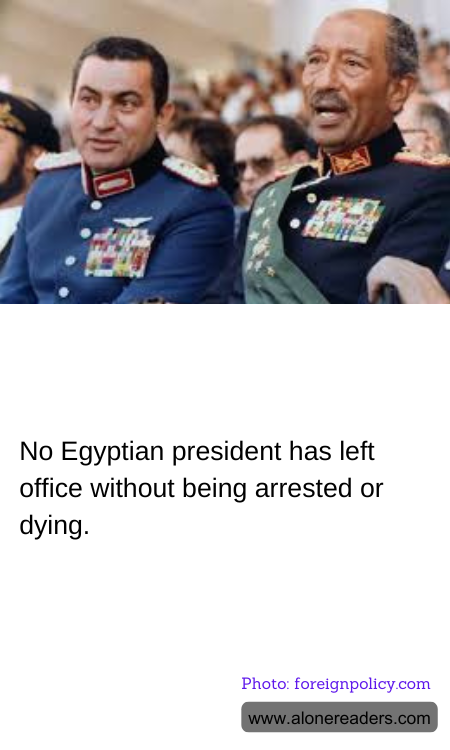
The political landscape of Egypt has been marked by a turbulent history, particularly concerning the fate of its presidents. Since the establishment of the republic in 1953, no Egyptian president has left office without either being arrested or dying, a pattern that underscores the volatility and challenges inherent in the country's governance.
The first president of Egypt, Mohamed Naguib, was a key figure in the Egyptian Revolution of 1952, which ended the monarchy. However, his tenure was short-lived. In 1954, he was placed under house arrest by his fellow revolutionaries, led by Gamal Abdel Nasser, who succeeded him. Nasser himself remained in power until his death in 1970, avoiding the fate of arrest but nonetheless illustrating the difficulty of a peaceful transition of power.
Anwar Sadat, Nasser's successor, initially enjoyed popularity for his role in the Yom Kippur War and subsequent peace treaty with Israel. However, his policies and peace efforts were met with internal dissent, culminating in his assassination in 1981 during a military parade. Sadat's death highlighted the intense political divisions and the risks faced by leaders attempting to navigate Egypt's complex political terrain.
Hosni Mubarak, who assumed the presidency following Sadat's assassination, ruled for nearly three decades. His tenure ended dramatically during the Arab Spring in 2011, a period of widespread protests across the Arab world. Mubarak was forced to resign and subsequently faced trial, becoming the first Egyptian president to be imprisoned. His arrest marked a significant moment in Egyptian history, as it demonstrated the potential for accountability, albeit under extraordinary circumstances.
Following Mubarak, Mohamed Morsi became Egypt's first democratically elected president. However, his presidency was short-lived, as he was ousted by the military in 2013 amid mass protests against his rule. Morsi was arrested and faced numerous charges, dying in custody in 2019. His removal and subsequent arrest underscored the persistent instability and the military's influential role in Egyptian politics.
The current president, Abdel Fattah el-Sisi, came to power following Morsi's ouster. While he remains in office, the historical pattern raises questions about the future and whether he will be able to break the cycle of arrest or death that has plagued his predecessors.
This pattern of presidential exits in Egypt reflects broader issues within the country's political system, including the lack of institutionalized mechanisms for peaceful transitions of power and the significant influence of the military. It also highlights the challenges of governance in a nation with deep-seated political, social, and economic issues. As Egypt continues to navigate its path forward, the hope remains that future leaders can find a way to break this historical cycle, paving the way for a more stable and democratic future.
