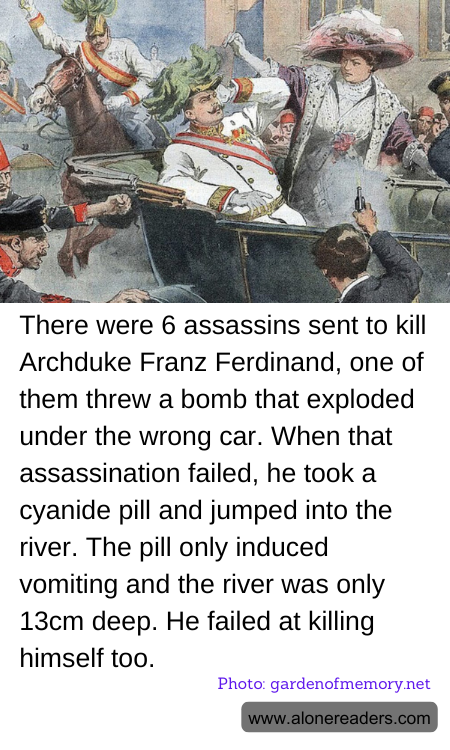
The assassination of Archduke Franz Ferdinand, heir to the Austro-Hungarian throne, on June 28, 1914, is often cited as the catalyst for World War I. However, the events leading up to his death were marked by a series of almost farcical mishaps that underscore the chaotic nature of the plot. Among the six assassins dispatched by the Black Hand, a secret Serbian society, was a young man named Nedeljko Cabrinovic, whose failed attempt at assassination became a story of misfortune and irony.
On that fateful day, Cabrinovic positioned himself along the route of the Archduke's motorcade in Sarajevo. As the procession approached, he hurled a hand grenade at the open car carrying Franz Ferdinand and his wife, Sophie. However, the bomb bounced off the folded-down convertible roof and exploded under the following vehicle, injuring several bystanders and members of the entourage but leaving the Archduke unharmed.
In the ensuing chaos, Cabrinovic attempted to evade capture by swallowing a cyanide pill and leaping into the nearby Miljacka River. Unfortunately for him, the cyanide pill was either old or improperly formulated, as it only induced severe vomiting rather than death. To add to his misfortune, the river was a mere 13 centimeters deep, rendering his dramatic escape attempt both ineffective and somewhat comical. Cabrinovic was quickly apprehended by the authorities, his failure at both assassination and suicide sealing his fate.
This botched attempt did not deter the other conspirators, and later that day, Gavrilo Princip succeeded in assassinating the Archduke and his wife. The assassination set off a chain of events that plunged Europe into one of the deadliest conflicts in history. Yet, Cabrinovic's story remains a testament to the unpredictability and often absurd nature of historical events.
The tale of Nedeljko Cabrinovic serves as a reminder of the human element behind historical narratives. His actions, driven by youthful zeal and nationalist fervor, were part of a larger, more complex web of political tensions and alliances. While his failure is often recounted with a touch of dark humor, it also highlights the tragic consequences of radical ideologies and the lengths individuals will go to for their beliefs.
In the grand tapestry of history, Cabrinovic's misadventures are a footnote, overshadowed by the monumental impact of the events they inadvertently set in motion. Yet, they offer a glimpse into the chaotic and often unpredictable nature of human endeavors, where even the best-laid plans can go awry in the most unexpected ways.
