More About This Card
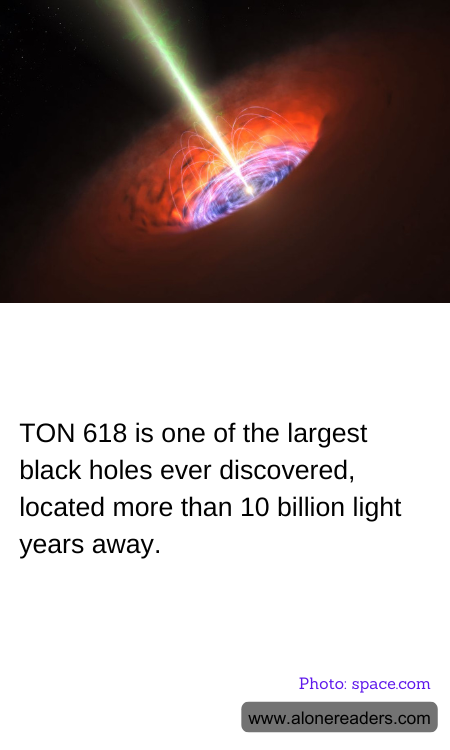
In the vast expanse of the universe, where mysteries abound and celestial wonders captivate our imaginations, TON 618 stands out as a cosmic giant. This supermassive black hole, one of the largest ever discovered, is located more than 10 billion light-years away from Earth. Its sheer size and distance make it a fascinating subject for astronomers and space enthusiasts alike.
TON 618 resides in a distant quasar, a type of active galactic nucleus that emits enormous amounts of energy. Quasars are powered by supermassive black holes at their centers, and TON 618 is no exception. With an estimated mass of 66 billion times that of our Sun, it dwarfs most other known black holes. To put this into perspective, the black hole at the center of our Milky Way galaxy, Sagittarius A*, is about 4 million solar masses, making TON 618 a true behemoth in the cosmic landscape.
The discovery of TON 618 dates back to the 1950s when it was first identified as a radio source. However, it wasn't until the 1970s that astronomers realized its true nature as a quasar. The light we see from TON 618 today began its journey over 10 billion years ago, offering a glimpse into the early universe. This time travel aspect of observing distant objects allows scientists to study the conditions and processes that shaped the cosmos in its formative years.
Despite its immense size and power, TON 618 remains a distant and enigmatic figure in the universe. Its location in the constellation Canes Venatici, far beyond the reach of current space exploration technology, means that direct observation is limited to telescopic data. However, the information gathered from these observations has provided valuable insights into the behavior and characteristics of supermassive black holes.
The study of TON 618 and other similar cosmic phenomena continues to push the boundaries of our understanding of the universe. It challenges existing theories about the formation and growth of black holes, prompting scientists to explore new models and hypotheses. As technology advances, future generations may unlock even more secrets about these colossal entities and their role in the cosmic tapestry.
For now, TON 618 remains a testament to the awe-inspiring scale and complexity of the universe. Its existence reminds us of the vastness of space and the endless possibilities that lie beyond our current knowledge. As we gaze up at the night sky, TON 618 serves as a beacon of curiosity and wonder, inspiring us to continue exploring the mysteries of the cosmos.