More About This Card
In the annals of art history, few moments capture the intersection of creativity and political commentary as poignantly as the exchange between Pablo Picasso and a German officer during World War II. This encounter, steeped in irony and profound truth, revolves around Picasso's masterpiece, "Guernica," a painting that stands as a stark testament to the horrors of war and the resilience of the human spirit.
"Guernica," created in 1937, was Picasso's visceral response to the bombing of the Basque town of Guernica during the Spanish Civil War. The attack, carried out by Nazi Germany's Luftwaffe in support of Francisco Franco's Nationalist forces, resulted in widespread devastation and loss of life. Picasso, deeply moved by the tragedy, channeled his outrage and sorrow into a sprawling mural that would become one of the most powerful anti-war statements in art history.
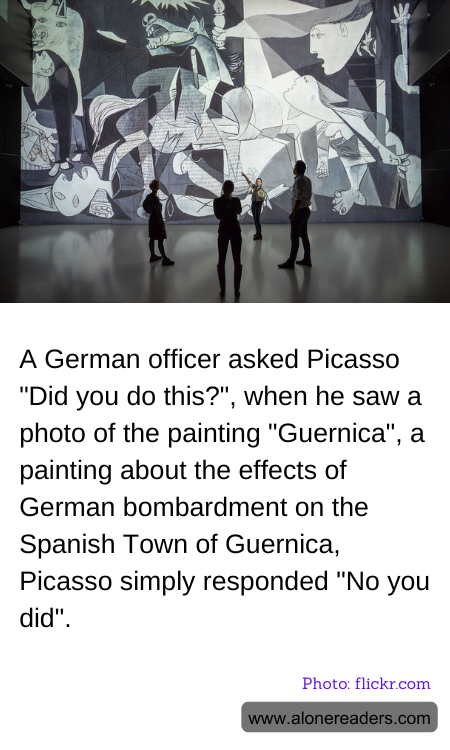
The painting itself is a chaotic tableau of suffering and despair. Its monochromatic palette of blacks, whites, and grays underscores the bleakness of the scene, while distorted figures and anguished faces convey the agony of the victims. A mother wails over her dead child, a horse writhes in pain, and a bull, a symbol of brutality and darkness, looms ominously. Through these images, Picasso captures the senselessness and brutality of war, making "Guernica" a universal symbol of the human cost of conflict.
The anecdote involving the German officer and Picasso adds a layer of irony and poignancy to the painting's legacy. During the Nazi occupation of Paris, where Picasso lived, a German officer reportedly visited the artist's studio and, upon seeing a photograph of "Guernica," asked, "Did you do this?" Picasso's retort, "No, you did," was a sharp rebuke, pointing directly at the culpability of the German forces in the atrocity depicted. This exchange not only highlights Picasso's courage and defiance in the face of oppression but also underscores the power of art as a form of resistance and truth-telling.
Picasso's response resonates beyond its historical context, serving as a reminder of the artist's role in society. Artists, through their work, have the ability to hold a mirror to the world, reflecting its beauty and its horrors, its triumphs and its failures. "Guernica" remains a timeless reminder of the devastation wrought by war and the enduring strength of the human spirit to confront and overcome such darkness.
In today's world, where conflicts continue to rage and the innocent suffer, Picasso's "Guernica" and his defiant words to the German officer continue to inspire and challenge us. They urge us to remember the past, to recognize the power of art to speak truth to power, and to strive for a future where peace and justice prevail.