More About This Card
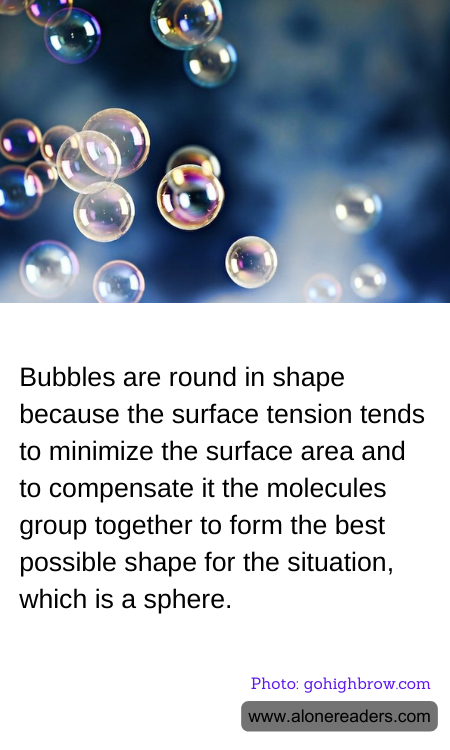
Bubbles are a fascinating phenomenon that captures the curiosity of people of all ages. Whether floating through the air or resting on a surface, bubbles are almost always round. This spherical shape is not just a random occurrence but a result of the intriguing interplay of physical forces, primarily surface tension.
Surface tension is a property of liquids that arises from the cohesive forces between molecules. In the case of a bubble, which is essentially a thin film of liquid enclosing a gas, surface tension plays a crucial role in determining its shape. The molecules in the liquid film are attracted to each other, and this attraction is stronger at the surface where the liquid meets the air. This creates a sort of "skin" on the surface of the liquid, which tends to contract and minimize its area.
The reason bubbles are round is that a sphere is the shape that has the smallest possible surface area for a given volume. When a bubble forms, the liquid film naturally seeks to minimize its surface area due to surface tension. By adopting a spherical shape, the bubble achieves this goal, as a sphere encloses the maximum volume with the least surface area compared to any other shape. This is why, regardless of how a bubble is formed, it will always try to become as spherical as possible.
This principle is not only limited to bubbles but is a fundamental concept in nature. Many natural phenomena and structures, from raindrops to planets, exhibit a tendency towards spherical shapes due to similar forces. The sphere's efficiency in minimizing surface area makes it a recurring theme in the natural world.
The beauty of bubbles lies not only in their shape but also in their fleeting nature. They are delicate and transient, often lasting only a few moments before bursting. This ephemeral quality adds to their allure, making them a source of endless fascination and joy. Children and adults alike are captivated by the sight of bubbles drifting through the air, shimmering with colors as they catch the light.
In conclusion, the round shape of bubbles is a perfect example of nature's tendency to find the most efficient solutions. Through the force of surface tension, bubbles naturally form into spheres, demonstrating a simple yet profound principle of physics. This understanding enhances our appreciation of the everyday wonders around us, reminding us of the intricate balance and beauty inherent in the natural world. Whether in a playful setting or a scientific exploration, bubbles continue to enchant and educate, offering a glimpse into the elegant simplicity of nature's designs.