More About This Card
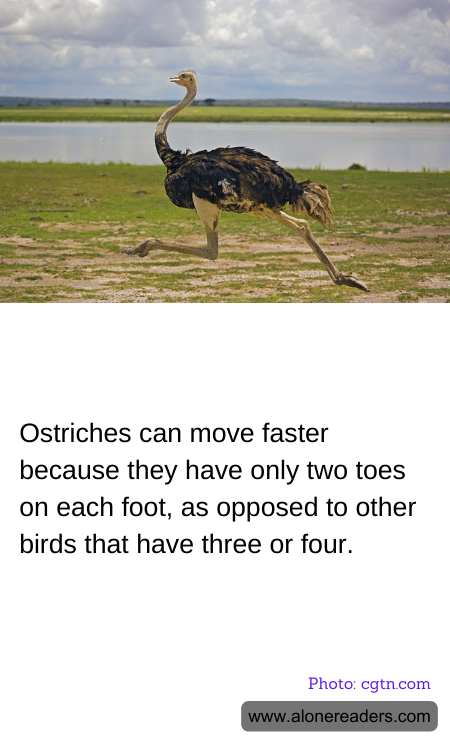
Ostriches, the world's largest birds, are renowned for their incredible speed and agility, which can be attributed to their unique foot structure. Unlike most birds that possess three or four toes on each foot, ostriches have evolved to have only two. This distinctive adaptation plays a crucial role in their ability to move swiftly across the African savannahs, reaching speeds of up to 45 miles per hour.
The two-toed design of an ostrich's foot is a marvel of evolutionary engineering. Each foot consists of a large, powerful toe equipped with a sharp claw, and a smaller, supportive toe. This configuration reduces the weight of their feet, allowing for greater speed and efficiency in movement. The larger toe bears most of the bird's weight and provides a strong push-off with each stride, while the smaller toe aids in balance and stability. This streamlined foot structure minimizes resistance and maximizes the ostrich's ability to cover vast distances quickly, a vital trait for escaping predators and searching for food.
In contrast, birds with three or four toes, such as chickens or ducks, have feet designed for different purposes. These birds often require more stability for perching, swimming, or scratching the ground, which is facilitated by their additional toes. However, this comes at the cost of speed and agility. The extra toes add weight and complexity, making it more challenging for these birds to achieve the same level of rapid movement as the ostrich.
The ostrich's remarkable speed is not only a testament to its unique foot structure but also to its overall anatomy. With long, powerful legs and a lightweight body, ostriches are built for endurance and speed. Their muscular legs act like springs, storing and releasing energy with each stride, propelling them forward with minimal effort. This efficient locomotion system allows ostriches to maintain high speeds over long distances, an essential survival trait in the wild.
Moreover, the ostrich's ability to run fast is complemented by its keen eyesight and acute sense of hearing, enabling it to detect threats from afar. This combination of speed, agility, and sensory awareness makes the ostrich a formidable creature in its natural habitat, capable of evading predators such as lions and hyenas.
In conclusion, the ostrich's two-toed feet are a key factor in its ability to move faster than many other birds. This evolutionary adaptation, combined with its powerful legs and keen senses, allows the ostrich to thrive in the challenging environments of the African plains. By understanding the unique characteristics of the ostrich's feet, we gain insight into the fascinating ways in which nature has equipped this remarkable bird for survival and success.