More About This Card
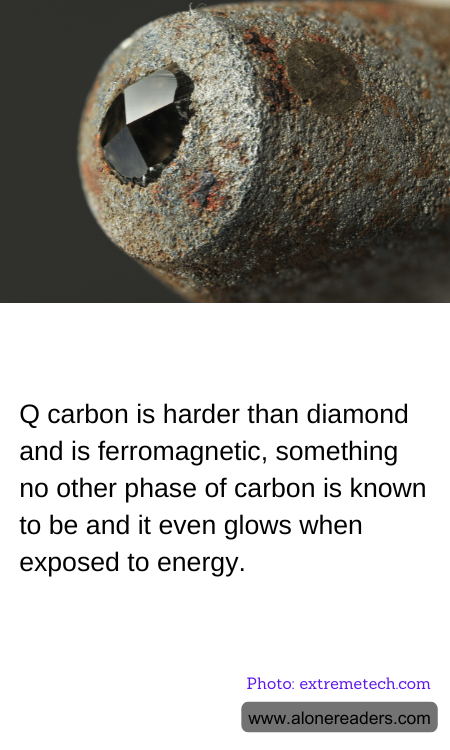
In the ever-evolving world of materials science, a groundbreaking discovery has emerged that challenges our understanding of carbon's capabilities. Q-carbon, a novel phase of carbon, has been found to possess remarkable properties that set it apart from its well-known counterpart, diamond. Not only is Q-carbon harder than diamond, but it also exhibits ferromagnetic properties, a characteristic previously unseen in any other phase of carbon. Additionally, this extraordinary material has the unique ability to glow when exposed to energy, opening up a realm of possibilities for its application in various fields.
The creation of Q-carbon involves a process that is both innovative and efficient. Scientists have developed a method that uses a laser to rapidly heat amorphous carbon, followed by a quick cooling process. This rapid quenching results in the formation of Q-carbon, a structure that is distinct from both graphite and diamond. The process is not only cost-effective but also environmentally friendly, as it does not require the high pressures and temperatures typically needed to produce synthetic diamonds.
One of the most striking features of Q-carbon is its hardness. While diamond has long been considered the hardest known natural material, Q-carbon surpasses it, offering a new benchmark for hardness. This property alone could revolutionize industries that rely on durable materials, such as cutting tools and abrasives. The enhanced hardness of Q-carbon could lead to the development of more efficient and longer-lasting products, reducing costs and improving performance across various sectors.
In addition to its impressive hardness, Q-carbon's ferromagnetic properties set it apart from other carbon phases. Ferromagnetism, the basic mechanism by which certain materials form permanent magnets, is a rare trait for carbon-based materials. This unique characteristic of Q-carbon could pave the way for advancements in magnetic storage technologies and electronic devices, offering new opportunities for innovation in data storage and processing.
Perhaps one of the most intriguing aspects of Q-carbon is its ability to emit light when exposed to energy. This luminescent property could have significant implications for the development of new lighting technologies and display systems. The potential for creating energy-efficient, glowing materials could lead to advancements in everything from consumer electronics to medical imaging devices.
The discovery of Q-carbon represents a significant leap forward in materials science, offering a glimpse into the untapped potential of carbon. As researchers continue to explore and refine the properties of Q-carbon, the possibilities for its application seem boundless. From revolutionizing industrial processes to enhancing electronic devices, Q-carbon stands as a testament to the power of scientific innovation and the endless potential of the natural world. As we continue to unlock the secrets of this remarkable material, the future of technology and materials science looks brighter than ever.