More About This Card
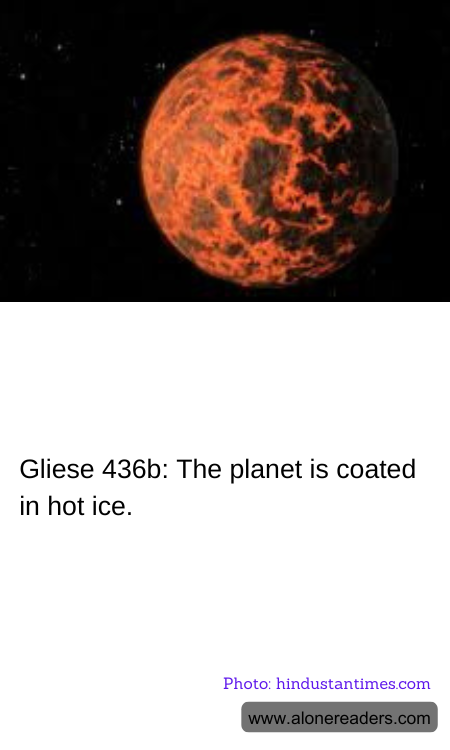
In the vast expanse of the universe, where celestial wonders abound, Gliese 436b stands out as a particularly intriguing exoplanet. Located approximately 30 light-years away in the constellation Leo, this distant world has captured the imagination of astronomers and space enthusiasts alike due to its unusual and seemingly paradoxical surface: it is coated in what scientists describe as "hot ice."
Discovered in 2004, Gliese 436b is a Neptune-sized exoplanet orbiting its host star, Gliese 436, at a remarkably close distance. This proximity results in extreme temperatures, with the planet's surface reaching a scorching 439 degrees Celsius (or about 822 degrees Fahrenheit). Despite these blistering conditions, the planet's surface is covered in ice, a phenomenon that defies our conventional understanding of how ice behaves.
The key to this enigma lies in the concept of "exotic ice." On Earth, ice forms when water freezes at temperatures below 0 degrees Celsius (32 degrees Fahrenheit). However, in the high-pressure environment of Gliese 436b, water behaves differently. The immense gravitational forces exerted by the planet's mass compress the water vapor in its atmosphere, forming a type of ice known as "Ice VII." This exotic form of ice remains solid even at extremely high temperatures due to the intense pressure, creating a surface that is simultaneously hot and icy.
This unique characteristic of Gliese 436b challenges our understanding of planetary science and expands the possibilities of what we might find on other worlds. It serves as a reminder that the universe is full of surprises, with conditions that can be vastly different from those on Earth. The study of such exoplanets not only enhances our knowledge of planetary formation and behavior but also fuels the search for potentially habitable worlds beyond our solar system.
The discovery of Gliese 436b and its hot ice surface has sparked curiosity and inspired further exploration into the nature of exoplanets. Scientists continue to study this celestial body using advanced telescopes and observational techniques, hoping to uncover more about its composition and the dynamics of its atmosphere. Each new piece of information brings us closer to understanding the diverse and complex nature of planets in our galaxy.
In essence, Gliese 436b is a testament to the wonders of the cosmos, illustrating that the universe is a place of infinite variety and mystery. As we continue to explore and learn, we are reminded of the boundless potential for discovery that lies beyond our own world, inviting us to look up and wonder what other marvels await in the vastness of space.