More About This Card
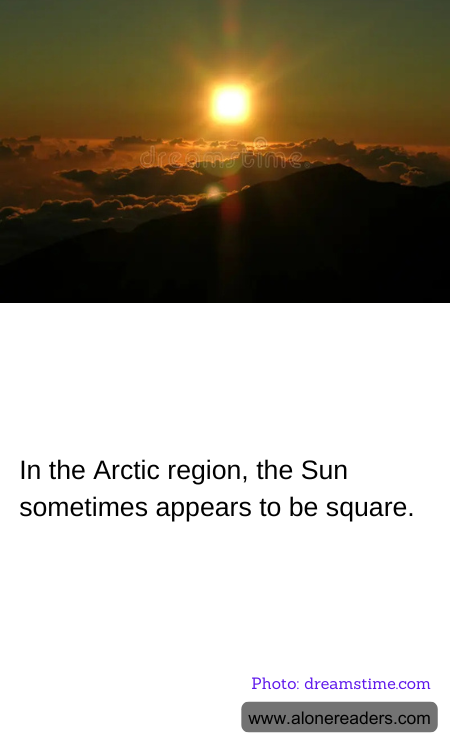
In the Arctic region, a fascinating and rare optical phenomenon occasionally occurs where the Sun appears to take on a square shape. This captivating sight, which defies the usual circular appearance of the Sun, is a result of unique atmospheric conditions that are more prevalent in polar regions. While it may sound like something out of a science fiction novel, the square Sun is a real occurrence that has intrigued scientists and sky watchers alike.
The square Sun phenomenon is primarily caused by a combination of temperature inversions and atmospheric refraction. In the Arctic, temperature inversions are common due to the extreme cold. Normally, air temperature decreases with altitude, but during an inversion, a layer of warmer air traps colder air below it. This inversion layer can bend light rays in unusual ways. When the Sun is low on the horizon, its light passes through a thicker layer of the Earth's atmosphere, which can cause the light to refract, or bend, more dramatically than usual.
This bending of light can distort the Sun's image, making it appear elongated, flattened, or even square. The refraction is more pronounced in the Arctic due to the extreme angles at which sunlight enters the atmosphere. The square appearance is often fleeting, lasting only a few minutes as the Sun rises or sets. It is most likely to be observed during the polar sunrise or sunset, when the Sun's rays skim the horizon and the atmospheric conditions are just right.
The square Sun is not only a visual spectacle but also a reminder of the complex interactions between light and the Earth's atmosphere. It highlights the dynamic nature of our planet's climate and the unique conditions that can arise in polar regions. For those fortunate enough to witness this rare event, it offers a glimpse into the wonders of atmospheric science and the beauty of natural phenomena.
For scientists, the square Sun provides an opportunity to study atmospheric conditions in extreme environments. Understanding how light behaves in these situations can offer insights into climate patterns and help refine models that predict weather and climate changes. For the general public, it serves as a reminder of the many mysteries that still exist in our natural world, waiting to be explored and understood.
In conclusion, the square Sun is a rare and intriguing phenomenon that captivates those who are lucky enough to see it. It is a testament to the wonders of nature and the intricate dance of light and atmosphere. Whether viewed as a scientific curiosity or a natural marvel, the square Sun is a reminder of the beauty and complexity of our world, inspiring awe and curiosity in equal measure.