More About This Card
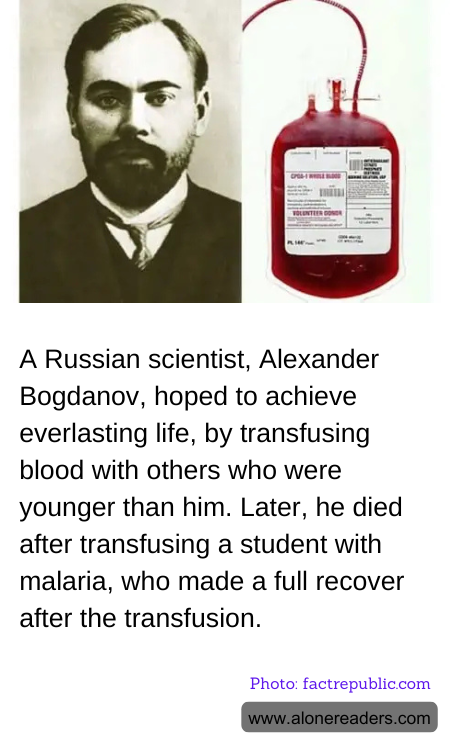
In the early 20th century, a Russian scientist named Alexander Bogdanov embarked on a quest that straddled the line between science and science fiction. Bogdanov, a polymath who was not only a physician but also a philosopher, economist, and science fiction writer, was captivated by the idea of achieving everlasting life. His method of choice was blood transfusion, a procedure that was still in its infancy at the time. Bogdanov believed that by transfusing blood from younger, healthier individuals into his own veins, he could rejuvenate his body and potentially extend his lifespan indefinitely.
Bogdanov's interest in blood transfusion was not purely theoretical. He conducted numerous experiments on himself and others, convinced that the procedure could offer a fountain of youth. He reported improvements in his eyesight, a cessation of balding, and a general sense of rejuvenation after undergoing transfusions. His enthusiasm for the potential of blood transfusion was infectious, and he soon gathered a group of followers who shared his vision of a future where aging could be halted or even reversed.
However, Bogdanov's experiments were not without risk. The science of blood transfusion was not well understood at the time, and the concept of blood types had only recently been discovered. This lack of knowledge would ultimately lead to Bogdanov's downfall. In a tragic twist of fate, Bogdanov died in 1928 after transfusing blood from a student who was unknowingly infected with malaria. Ironically, the student made a full recovery after the transfusion, while Bogdanov succumbed to the disease.
Bogdanov's death was a sobering reminder of the dangers inherent in medical experimentation, especially when conducted without a full understanding of the underlying science. Yet, his pioneering work laid the groundwork for future research into blood transfusion and its potential benefits. Today, blood transfusions are a routine medical procedure that save countless lives, and research into the rejuvenating effects of young blood continues, albeit with a much more rigorous scientific approach.
While Bogdanov's dream of achieving everlasting life through blood transfusion remains unfulfilled, his legacy endures in the annals of medical history. His story serves as both a cautionary tale and an inspiration, highlighting the fine line between visionary innovation and reckless experimentation. As science continues to explore the mysteries of aging and rejuvenation, Bogdanov's quest for eternal youth reminds us of the enduring human desire to transcend the limits of mortality.