More About This Card
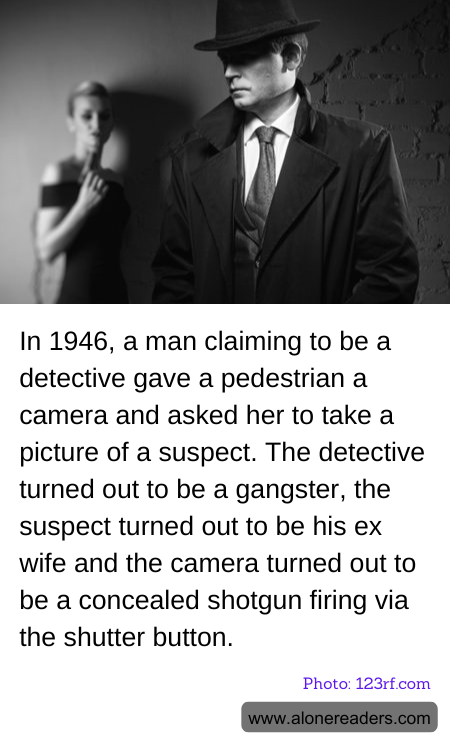
In the bustling post-war era of 1946, a peculiar and chilling incident unfolded on the streets, blending deception with danger in a manner that seemed almost cinematic. A man, presenting himself as a detective, approached an unsuspecting pedestrian with an unusual request. He handed her a camera, asking her to take a picture of a supposed suspect. The pedestrian, perhaps intrigued by the opportunity to assist in what seemed like a legitimate law enforcement operation, agreed to help. Little did she know, she was about to become an unwitting participant in a sinister plot.
The man, who appeared to be a detective, was in fact a gangster with a malicious agenda. His target was not a criminal on the run, but rather his ex-wife, whom he had marked for a deadly encounter. The camera, seemingly an innocuous tool for capturing images, was ingeniously rigged to serve a far more lethal purpose. Concealed within its casing was a shotgun, designed to discharge when the shutter button was pressed. This deadly device was a testament to the lengths to which the gangster was willing to go to achieve his nefarious goals.
As the pedestrian aimed the camera and pressed the shutter, the concealed weapon fired, transforming an ordinary moment into a scene of chaos and tragedy. The ex-wife, unsuspecting and unaware of the danger she was in, became the victim of a calculated act of violence. The pedestrian, horrified by the unexpected outcome, was left to grapple with the realization that she had been manipulated into committing an unthinkable act.
This incident serves as a stark reminder of the complexities and dangers that can lurk beneath seemingly ordinary interactions. It highlights the potential for deception in a world where appearances can be deceiving, and where trust can be exploited by those with malicious intent. The story of the camera-turned-weapon underscores the importance of vigilance and skepticism, even in situations that appear benign.
In the aftermath, the pedestrian's life was undoubtedly changed forever, burdened with the knowledge of her unwitting involvement in a crime. The gangster's cunning plan, while initially successful, ultimately unraveled, revealing the depths of his treachery. This tale from 1946 remains a haunting example of how easily trust can be manipulated and how quickly innocence can be shattered by the machinations of those with dark intentions.