More About This Card
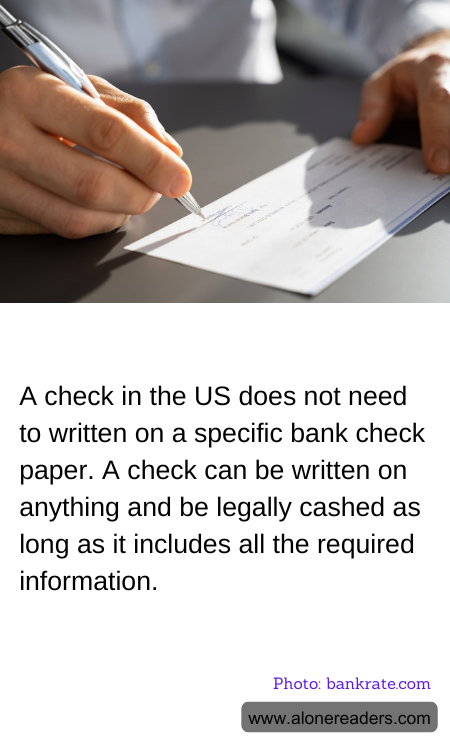
In the United States, the concept of what constitutes a valid check is surprisingly flexible. While most people are accustomed to the traditional bank-issued checkbooks, the truth is that a check can be written on virtually anything, as long as it includes all the necessary information. This flexibility is rooted in the Uniform Commercial Code (UCC), which governs commercial transactions in the U.S. and does not specify the material on which a check must be written.
The essential elements that must be present for a check to be considered valid include the date, the payee's name, the amount to be paid (both in numerical and written form), the payer's signature, and the bank's routing and account numbers. As long as these components are clearly included, the check can technically be written on any medium. This means that a check could be written on a napkin, a piece of cardboard, or even a shirt, and still be legally cashed, provided it is legible and contains all the required information.
This unconventional approach to check writing is not just a theoretical possibility. There have been instances where people have successfully cashed checks written on unusual items. For example, in 1995, a man famously wrote a check on the side of a cow and managed to cash it. While such cases are rare and often serve more as anecdotes than common practice, they highlight the flexibility of the system.
However, while it is legally permissible to write a check on anything, it is not always practical. Banks and financial institutions are accustomed to processing standard checks, and presenting a check on an unusual medium could lead to delays or complications. Bank tellers may be unfamiliar with handling non-standard checks, and the check may need to be reviewed by a manager or sent to a specialized department for processing. Additionally, the durability and legibility of the medium are important considerations; a check written on a fragile or easily damaged material might not withstand the handling required during processing.
For most people, sticking to traditional checkbooks is the most convenient and efficient option. These checks are designed to be easily processed by banks, with standardized sizes and layouts that facilitate quick and accurate handling. However, the knowledge that checks can be written on anything provides an interesting insight into the flexibility of financial transactions and the importance of the information contained within the check, rather than the medium itself.
In conclusion, while the idea of writing a check on an unconventional item might seem novel or amusing, it is a testament to the adaptability of the financial system. As long as all the necessary information is present and legible, the medium of the check is secondary. This flexibility underscores the principle that in financial transactions, the content is king, and the form is merely a vessel.