More About This Card
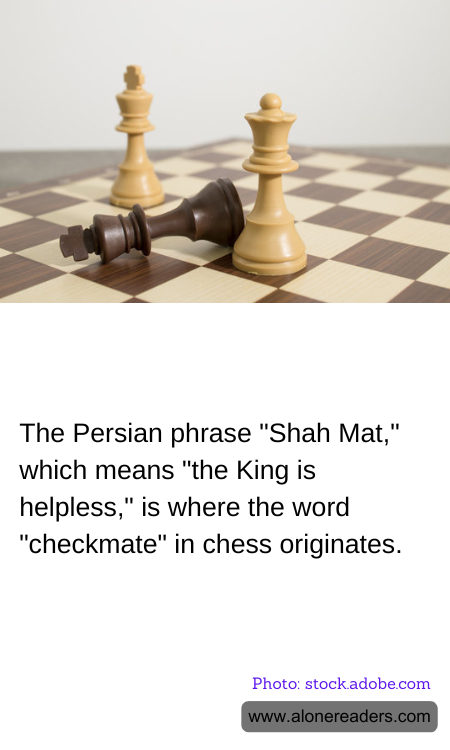
The game of chess, with its intricate strategies and timeless appeal, has captivated players for centuries. Among its many terms, "checkmate" stands out as the ultimate goal, signaling the end of a game when a player's king is trapped with no escape. The origin of this term is as fascinating as the game itself, tracing back to the Persian phrase "Shah Mat," which translates to "the King is helpless."
Chess is believed to have originated in India around the 6th century, where it was known as "Chaturanga." As the game spread across Asia and into Persia, it evolved, and with it, the terminology adapted to new languages and cultures. In Persia, the game was called "Shatranj," and it was during this period that the phrase "Shah Mat" became integral to the game. "Shah" means "king" in Persian, and "Mat" means "helpless" or "defeated." Thus, "Shah Mat" succinctly captured the essence of the game’s objective: to corner the opponent's king into a position from which it cannot escape.
As chess continued its journey westward, reaching the Islamic world and eventually Europe, the Persian terminology was retained but gradually transformed. The phrase "Shah Mat" was adapted into the medieval Latin "Escac Mat," which then evolved into the Old French "Echec et Mat." From there, it entered the English language as "checkmate." Despite the linguistic changes, the core meaning remained intact, preserving the dramatic moment when a king is rendered defenseless.
The adoption of "Shah Mat" into the lexicon of chess is a testament to the game's rich cultural tapestry. It highlights how chess has served as a bridge between civilizations, carrying with it not only strategic concepts but also linguistic and cultural exchanges. This phrase encapsulates the universal appeal of chess, a game that transcends borders and languages, uniting people in a shared intellectual pursuit.
For modern chess enthusiasts, understanding the origins of "checkmate" adds depth to the experience of the game. It serves as a reminder of the historical journey chess has undertaken and the diverse influences that have shaped it into the beloved pastime it is today. Whether played in a quiet park, a bustling tournament, or online, the declaration of "checkmate" continues to resonate with players, echoing the ancient Persian acknowledgment of a king's ultimate vulnerability.
In essence, the phrase "Shah Mat" is more than just a linguistic artifact; it is a symbol of chess's enduring legacy and its ability to connect people across time and space. As players declare "checkmate," they participate in a tradition that has been passed down through generations, celebrating both the strategic triumph and the rich history embedded within the game.