More About This Card
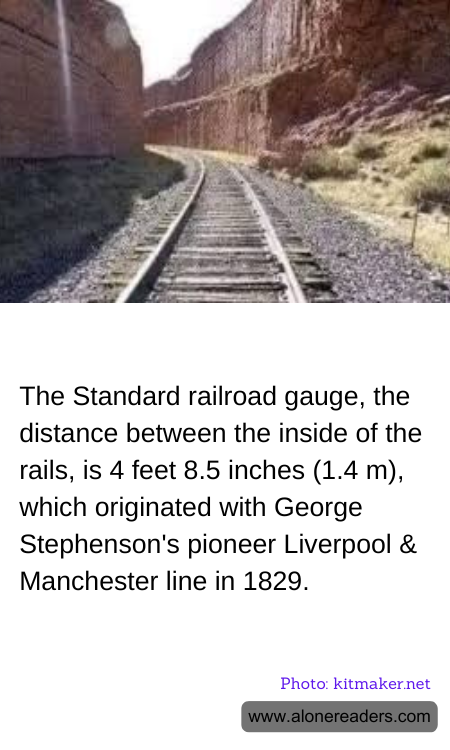
The standard railroad gauge, measuring 4 feet 8.5 inches (1.4 meters) between the inside of the rails, is a fascinating aspect of railway history that traces its origins back to the early 19th century. This specific measurement, often referred to as the "Stephenson gauge," is named after George Stephenson, a pioneering engineer whose work on the Liverpool & Manchester Railway in 1829 set the foundation for modern rail transport.
George Stephenson, often hailed as the "Father of Railways," was instrumental in developing the first inter-city railway line that used steam locomotives. His choice of gauge was not arbitrary but rather a practical decision influenced by existing practices. At the time, horse-drawn wagons used for coal mining in England operated on wooden tracks with a similar gauge. By adopting this measurement, Stephenson ensured compatibility with existing infrastructure, facilitating a smoother transition to steam-powered railways.
The adoption of the 4 feet 8.5 inches gauge was not without its challenges. During the early days of railway expansion, there was no standardized gauge, leading to what became known as the "gauge wars." Different regions and countries experimented with various gauges, resulting in a lack of interoperability between railway networks. This inconsistency posed significant logistical challenges, as goods and passengers had to be transferred between trains of different gauges, causing delays and increasing costs.
Despite these initial hurdles, the Stephenson gauge gradually gained acceptance due to its practicality and the success of the Liverpool & Manchester Railway. As railways expanded across the globe, the need for a standardized gauge became increasingly apparent. The 4 feet 8.5 inches gauge was eventually adopted as the standard in many countries, including the United States, Canada, and much of Europe, facilitating international trade and travel.
Today, the standard gauge remains the most widely used railway gauge in the world, covering approximately 60% of the global railway network. Its widespread adoption has played a crucial role in the development of efficient and interconnected rail systems, enabling the seamless movement of goods and people across vast distances. The legacy of George Stephenson's pioneering work continues to influence modern rail transport, underscoring the importance of standardization in fostering technological progress and economic growth.
In conclusion, the standard railroad gauge of 4 feet 8.5 inches is more than just a technical specification; it is a testament to the ingenuity and foresight of early railway pioneers like George Stephenson. By choosing a gauge that balanced practicality with existing practices, Stephenson laid the groundwork for a global railway network that continues to drive economic and social development to this day.