More About This Card
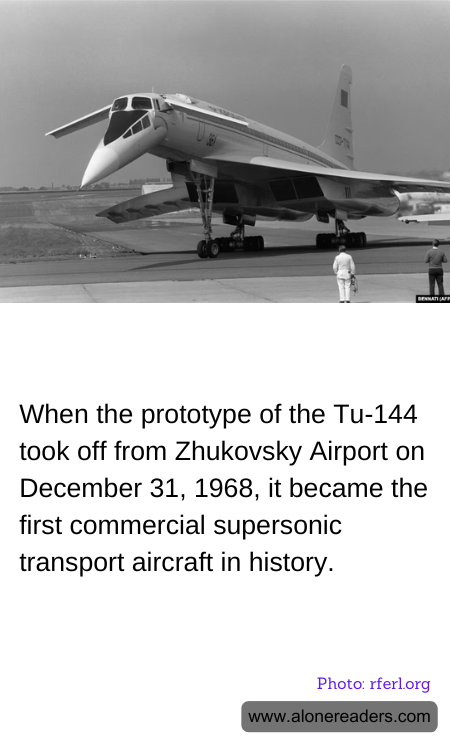
On December 31, 1968, a remarkable event unfolded at Zhukovsky Airport near Moscow, marking a significant milestone in aviation history. The prototype of the Tupolev Tu-144, a marvel of Soviet engineering, took to the skies, becoming the first commercial supersonic transport aircraft to achieve flight. This historic moment not only showcased the technological prowess of the Soviet Union but also set the stage for a new era in air travel, promising to revolutionize the way people traversed the globe.
The Tu-144, often referred to as "Concordski" due to its resemblance to the Anglo-French Concorde, was a product of intense competition during the Cold War. Both the Soviet Union and Western nations were racing to develop supersonic passenger jets, aiming to reduce travel times dramatically. The Tu-144's maiden flight was a testament to the Soviet Union's commitment to innovation and its desire to lead in the field of aviation technology. Designed by the Tupolev Design Bureau, the aircraft was a symbol of national pride and a demonstration of the Soviet Union's capabilities on the world stage.
The development of the Tu-144 was not without its challenges. Engineers faced numerous technical hurdles, from designing an airframe capable of withstanding the stresses of supersonic speeds to developing engines powerful enough to propel the aircraft beyond the speed of sound. Despite these obstacles, the Soviet team persevered, driven by a combination of national ambition and scientific curiosity. The successful takeoff of the Tu-144 prototype was a culmination of years of research, testing, and refinement, highlighting the dedication and ingenuity of those involved in the project.
While the Tu-144's first flight was a groundbreaking achievement, its journey was fraught with difficulties. The aircraft faced several technical issues during its operational life, including problems with its engines and airframe. These challenges, coupled with economic and political factors, limited the Tu-144's commercial success. Nevertheless, the aircraft made a lasting impact on the aviation industry, contributing valuable insights into supersonic flight and influencing future aircraft designs.
The legacy of the Tu-144 extends beyond its technical achievements. It served as a catalyst for international collaboration and competition, pushing the boundaries of what was possible in aviation. Although the Tu-144's operational life was short-lived, its pioneering spirit continues to inspire engineers and aviators around the world. The aircraft's historic first flight remains a testament to human ingenuity and the relentless pursuit of progress, reminding us of the incredible feats that can be accomplished when vision and determination converge.