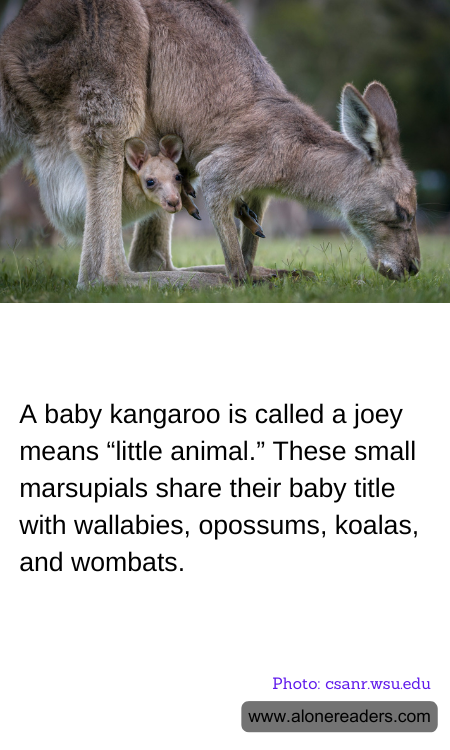
More About This Card
In the fascinating world of marsupials, the term "joey" holds a special place. A baby kangaroo, known as a joey, is a symbol of the unique and diverse wildlife found in Australia. The word "joey" translates to "little animal," a fitting description for these tiny creatures that begin their lives in a remarkable way. While kangaroos are the most famous bearers of this title, they are not alone. Other marsupials, such as wallabies, opossums, koalas, and wombats, also share the endearing name of joey for their young.
Marsupials are a group of mammals best known for their distinctive reproductive process. Unlike placental mammals, marsupials give birth to relatively undeveloped young, which then continue to grow and develop outside the womb, typically in a pouch on the mother's belly. This pouch, or marsupium, provides a safe and nurturing environment where the joey can latch onto a teat and receive nourishment while it grows. The journey from birth to independence is a fascinating one, filled with unique adaptations that have evolved over millions of years.
Kangaroos, perhaps the most iconic of all marsupials, are known for their powerful hind legs and ability to cover great distances in leaps and bounds. A newborn kangaroo joey is incredibly small, about the size of a jellybean, and is born blind and hairless. Immediately after birth, it instinctively crawls into its mother's pouch, where it will spend several months growing and developing. During this time, the joey is entirely dependent on its mother for warmth, protection, and nutrition.
Wallabies, which are closely related to kangaroos, also give birth to joeys. These smaller relatives share many of the same characteristics and behaviors as kangaroos, including the use of a pouch for rearing their young. Similarly, koalas, known for their tree-dwelling lifestyle and eucalyptus diet, also have joeys. A koala joey will spend the first six months of its life in its mother's pouch before venturing out to explore the world around it.
Opossums and wombats, while less commonly associated with the term joey, are also part of this marsupial family. Opossums, found primarily in the Americas, have a more varied diet and are known for their ability to adapt to different environments. Wombats, on the other hand, are burrowing animals native to Australia, known for their sturdy build and nocturnal habits. Despite their differences, all these marsupials share the common trait of nurturing their young in a pouch, highlighting the incredible diversity and adaptability of this group of mammals.
The term "joey" is a testament to the shared characteristics and evolutionary history of these remarkable animals. It serves as a reminder of the interconnectedness of life and the wonders of nature. Whether it's a kangaroo bounding across the Australian outback or a koala nestled in the branches of a eucalyptus tree, the journey of a joey from birth to independence is a captivating story of survival and growth.