More About This Card
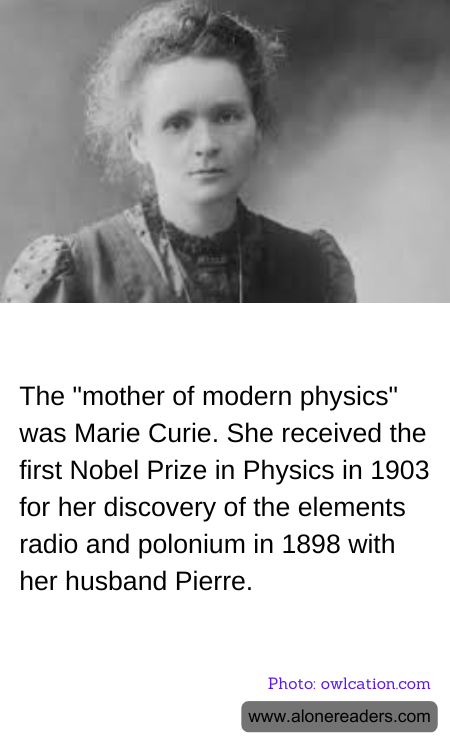
Marie Curie, often hailed as the "mother of modern physics," stands as a towering figure in the annals of scientific history. Her groundbreaking work in the late 19th and early 20th centuries laid the foundation for many of the advancements in physics and chemistry that followed. Born Maria Sklodowska in Warsaw, Poland, in 1867, Curie's journey to becoming a scientific pioneer was marked by perseverance, dedication, and an unyielding quest for knowledge.
In 1898, alongside her husband Pierre Curie, Marie Curie made a discovery that would change the scientific landscape forever. The couple identified two new elements: radium and polonium. These elements were not only significant in their own right but also pivotal in advancing the understanding of radioactivity, a term that Marie herself coined. Their work was revolutionary, challenging existing scientific paradigms and opening new avenues for research in both physics and chemistry.
The significance of their discovery was recognized globally, and in 1903, Marie Curie, along with Pierre and Henri Becquerel, was awarded the Nobel Prize in Physics. This accolade was particularly noteworthy as it marked the first time a woman had received the prestigious award. The Nobel Prize acknowledged their extraordinary contributions to the study of radioactivity, a field that would later prove crucial in medical treatments, energy production, and understanding atomic structures.
Marie Curie's achievements were not confined to her scientific discoveries. She broke barriers in a male-dominated field, inspiring generations of women to pursue careers in science and technology. Her relentless pursuit of knowledge and her ability to overcome societal and personal challenges have made her a symbol of resilience and intellect. Despite the risks associated with her research, which ultimately affected her health, Curie's commitment to science never wavered.
Her legacy extends beyond her scientific contributions. Marie Curie's life and work have inspired countless biographies, films, and educational programs, ensuring that her story continues to motivate and educate future generations. Her dedication to science and her pioneering spirit remain a beacon for those who dare to challenge the status quo and push the boundaries of human understanding.
In an era where women were often relegated to the sidelines, Marie Curie's achievements were nothing short of extraordinary. Her work not only advanced the field of physics but also paved the way for future discoveries that have had a profound impact on the world. As we reflect on her contributions, it is clear that Marie Curie was not just the "mother of modern physics" but also a trailblazer whose influence transcends time and discipline.